UK Homebuyer’s Guide · Trusted Cleanerz Ltd
Should You Buy a House Covered in Ivy? What Every Homebuyer Should Know
Ivy can make a home look beautiful—but who controls it, how easy is it to maintain, and what might be hidden behind the leaves?
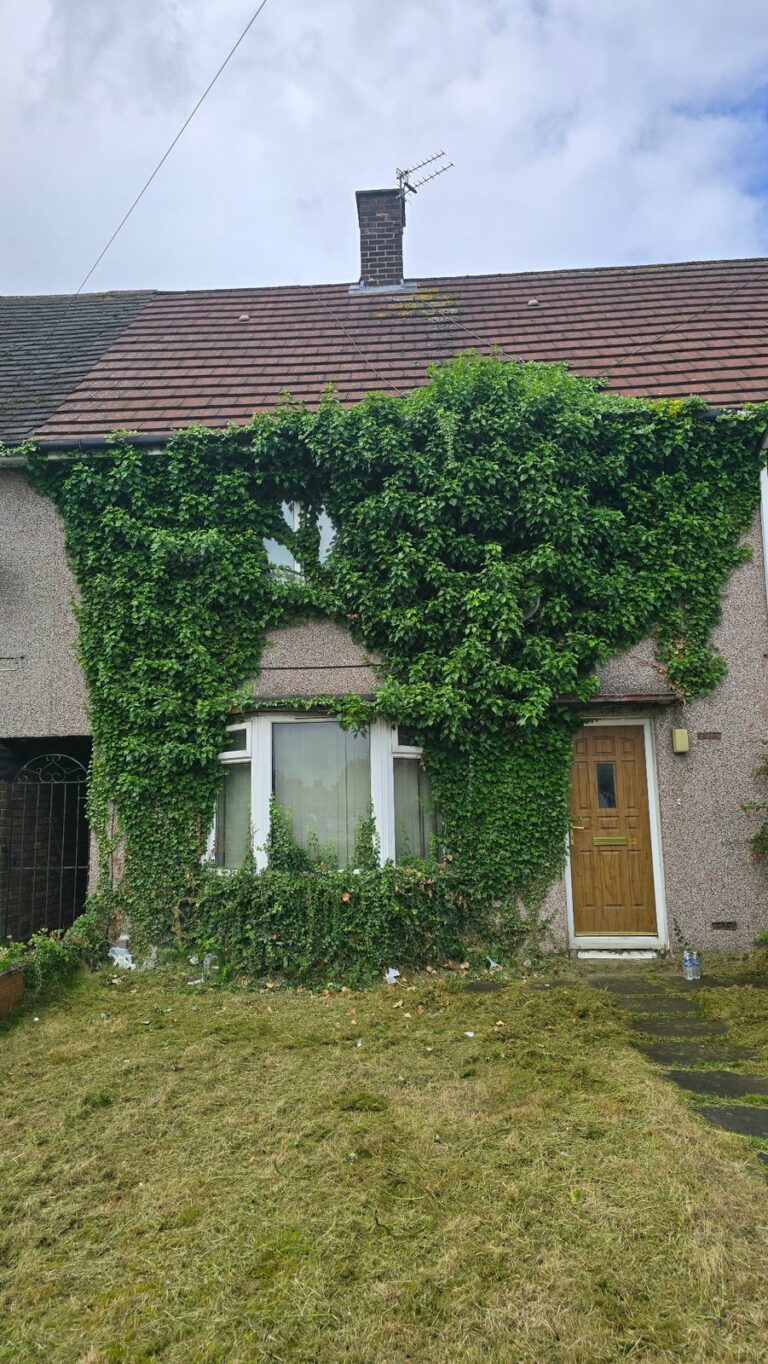
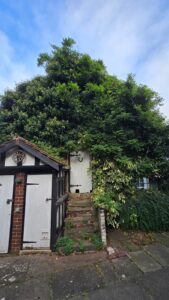
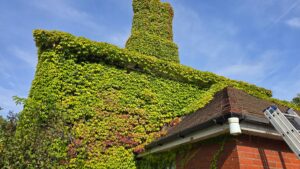
You find a characterful old house with ivy covering much of its brickwork or stonework. It looks attractive, but you begin wondering what you might be taking on if you buy it. Is the wall sound? How long has the ivy been there? What happens if it spreads across the roof—or from a neighbour’s garden?
Buying a house covered in ivy is not automatically a bad idea. The important distinction is often between a plant that has been regularly managed and one that has been allowed to grow unchecked for years. A buyer also needs to think about access, ongoing costs and whether the ivy is rooted on their own land.
1. Is Buying an Ivy-Covered House a Good Idea?
It can be. Ivy provides wildlife habitat and can even protect masonry against certain weather effects. The Royal Horticultural Society explains that its small aerial attachment roots generally do not penetrate sound masonry. Research published by Historic England also shows how an ivy covering can moderate some changes in temperature and moisture at the wall surface.
But ivy can grow into existing cracks and vulnerable areas, restrict inspections and spread around features that need routine maintenance. Whether it is sensible to keep it depends on the actual building, not simply the amount of green foliage.
It helps to treat ivy as a maintenance consideration, similar to an established tree, rather than a reason to avoid an otherwise suitable home.
2. Well-Maintained Ivy vs Neglected Ivy
What does well-maintained ivy look like?
The growth is regularly cut back, windows and vents stay clear, gutters and the roofline remain accessible, and the owner understands how to manage the plant. There may be years of healthy ivy coverage with relatively little disruption to a sound building.
Warning signs of neglected growth
Be more cautious if the ivy has formed a thick woody mass, covers several storeys, blocks windows, conceals guttering or spreads across the roof edge. If large areas of wall haven’t been visible for years, their current condition may be uncertain.
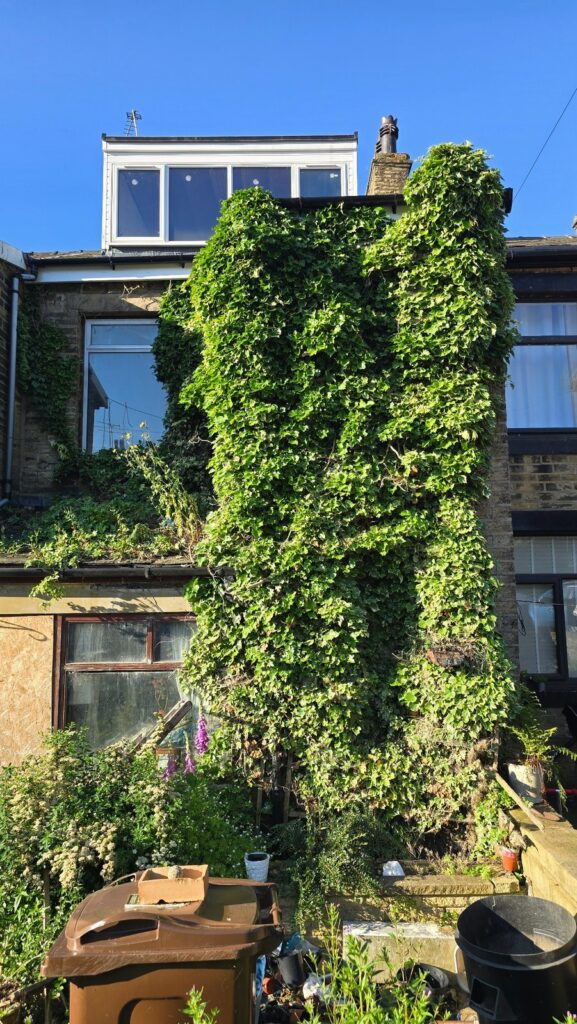
A house with maintained ivy may be a more reassuring purchase than a house with neglected ivy. But maintenance is not a guarantee: the building still needs an appropriate survey.
3. How Old and Established Is the Ivy?
Knowing the plant’s precise age is less important than understanding how mature it has become. Young stems on an accessible wall are often relatively simple to trim. Established ivy can develop thick woody stems that intertwine with gutter brackets, pipes, timbers and roofline details.
Why thick woody stems matter
Mature stems can be harder to cut into manageable sections and remove without disturbing fragile surfaces. In particular, look for stems that disappear into roof edges, behind boards or through gaps in older structures.
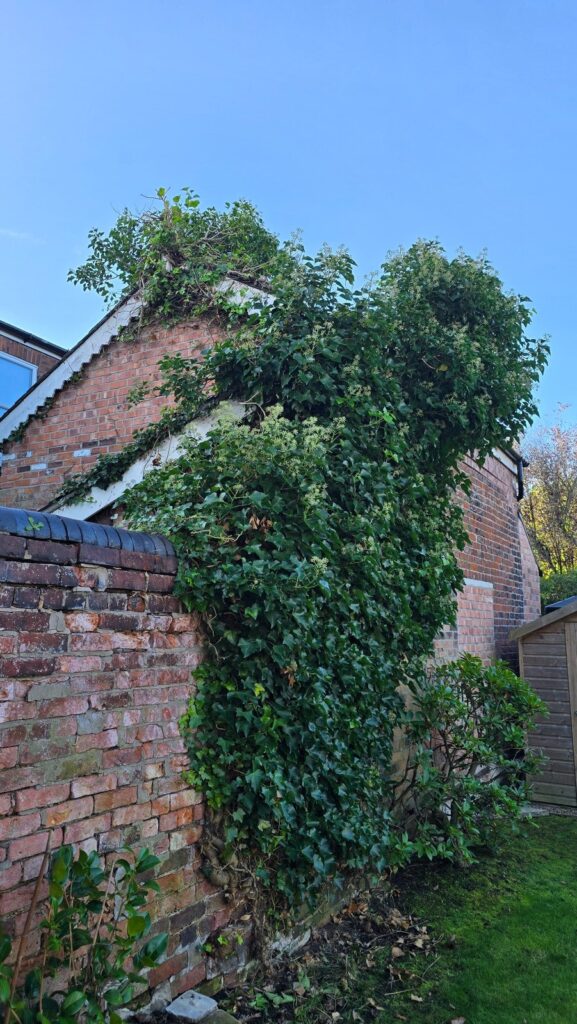
There is an important difference between aerial attachment roots, which cling to a wall, and feeding roots, which generally draw water and nutrients from the ground. Ivy can also develop roots in suitable cracks and pockets of material. We explain this in greater detail in our article about how deep ivy roots grow.
4. Is the Ivy Yours or Your Neighbour’s?
This question is especially important with terraced houses, semi-detached properties and buildings near boundaries. Ivy doesn’t recognise property lines. It may start on one side of a wall and extend onto someone else’s house.
When your ivy spreads onto a neighbouring property
You could inherit an existing problem involving a neighbour’s gutters, windows or roofline. Ask the seller whether there have been complaints, previous trimming arrangements or difficulty obtaining access for maintenance.
When your neighbour’s ivy grows onto your house
The vegetation affecting the building you want to buy might be rooted next door. Even where the growth can be trimmed on your side, you may have limited control over the source of the plant. Removing roots or carrying out work on neighbouring land may require agreement or professional advice.
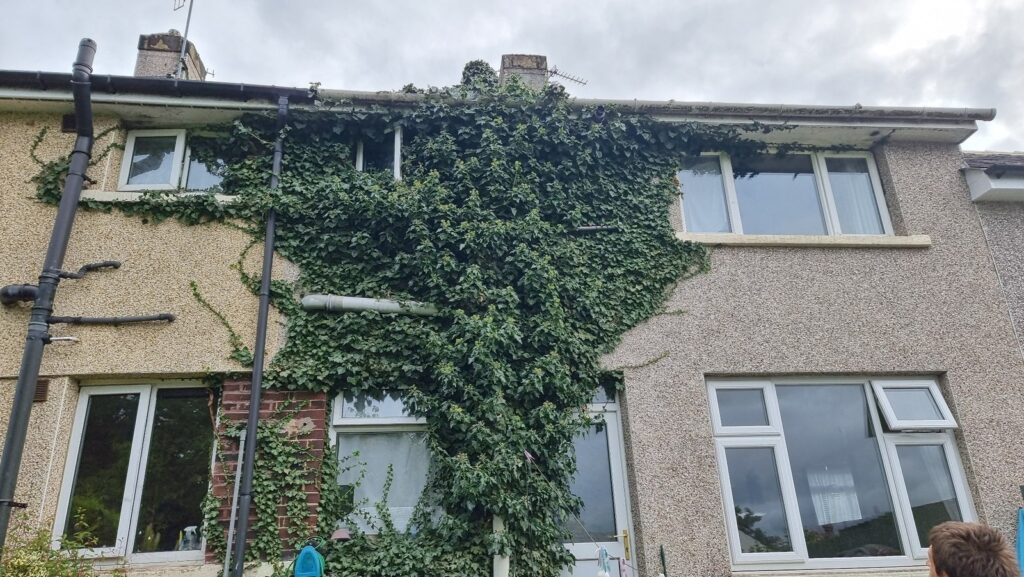
What happens if the neighbouring home is sold or rented?
The current neighbour might carefully maintain their ivy every year. But what happens if they sell the house and the next owner or tenant neglects it? A plant that was under control when you bought your home may later grow across your roofline.
That future risk is difficult to predict, so buyers should establish where the ivy originates and how dependent its upkeep is on another household.
Our UK Ivy Removal Report, examining 55 of our recent completed jobs, recorded neighbour or boundary concerns in 31% of cases. They were the most common primary reason for removal, at 20%. This reflects our specialist jobs, not all UK homes, but it shows how important neighbouring vegetation can be to property owners.
See also our more detailed guide to a neighbour’s ivy growing onto your house. For a real boundary or legal disagreement, consult your conveyancer.
5. How Easy Will the Ivy Be to Maintain or Remove?
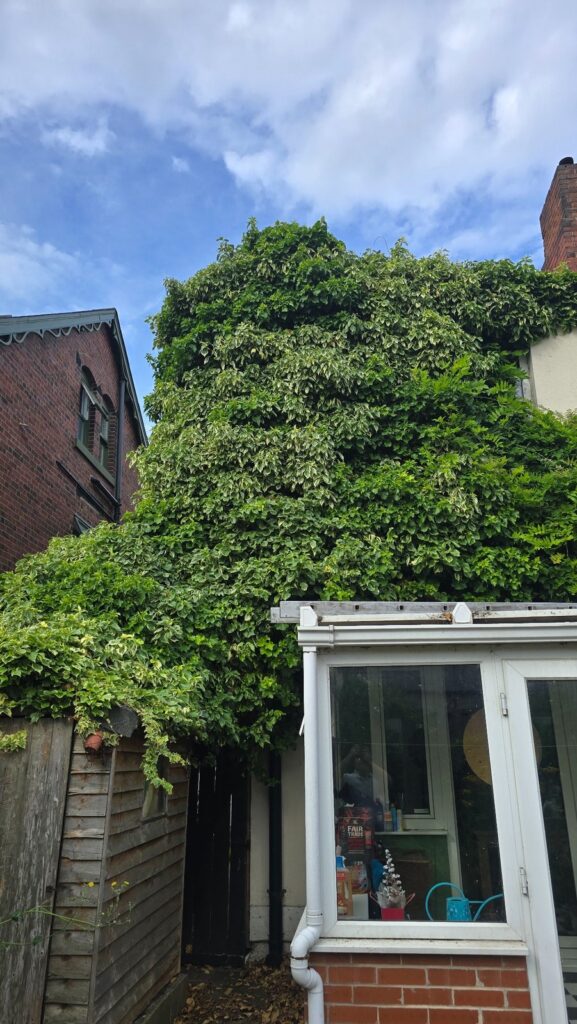
Imagine two ivy-covered houses. At one, the plant covers a low wall that can be maintained from safe, straightforward access. At the other, it climbs above a three-storey roofline, with a conservatory below and no easy position for access equipment. The second property could carry a much higher maintenance cost, even if its walls are in good condition.
Height, conservatories and restricted access
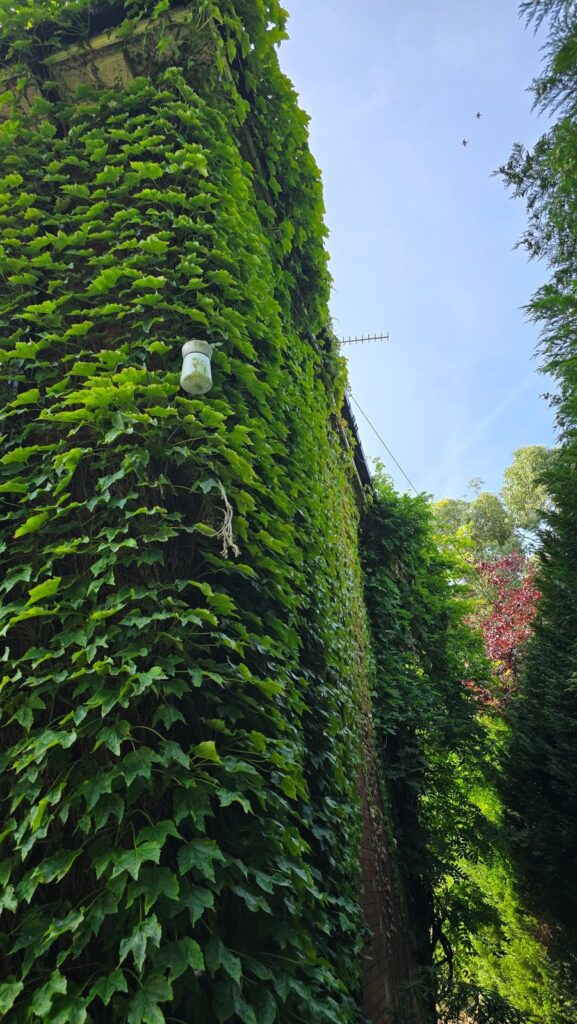
Look at side passages, slopes, extensions, glass roofs, overhead cables and any other obstacles. These may make it difficult to work safely, especially around the highest parts of the plant. Do not assume that every section can be reached using ladders.
Future maintenance costs
If you intend to keep the ivy, ask how often it has been trimmed and whether you will be able to continue that work. Over a five- or ten-year period, regular specialist access can cost more than buyers initially expect. Ongoing maintenance should be part of the property budget.
6. What Could Be Hiding Behind the Ivy?
Dense ivy makes it difficult to inspect a building’s exterior. During our work, we have encountered loose pointing, worn paint or render, deteriorated timber, old brackets and displaced guttering behind heavy growth. Some of these problems were already present before the ivy covered them; finding a defect after removal does not automatically prove the ivy caused it.
Brickwork, pointing and render
Look at exposed areas for cracks, missing mortar or loose finishes. If materials are already weak, pulling ivy away forcefully may cause additional damage.
Roof tiles, gutters and timber rooflines
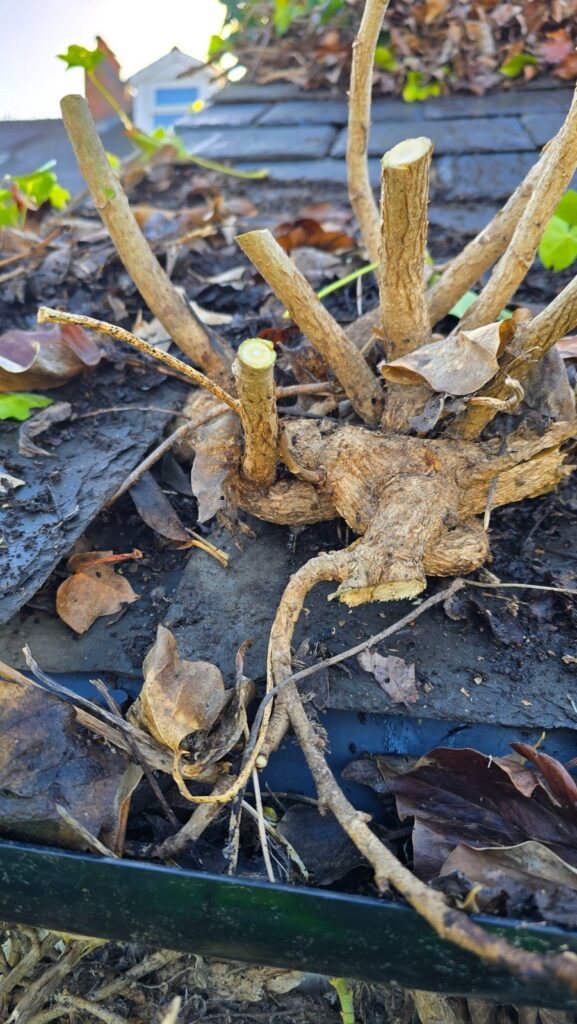
Pay attention to growth around fascia boards, eaves, chimneys, slates and tiles. Stems may enter gaps where repairs are more involved than trimming a wall.
Windows, ventilation and dampness
Check that windows, drainage outlets and airbricks are visible and clear. Ivy is not automatically responsible for damp: it may shield some walls from rain, while in other situations it conceals existing water-related defects or obstructs maintenance.
7. What Should You Ask Your Property Surveyor to Check?
Tell the surveyor how much ivy is present and ask them to identify anything they cannot inspect. A detailed survey such as a RICS Home Survey Level 3 may be appropriate for an older or more complex property; your surveyor can advise on the suitable survey level.
What a survey cannot reveal beneath heavy growth
A survey cannot always establish what lies beneath dense vegetation. It may record the inspection as limited and recommend further investigation. Ask what that uncertainty means before you exchange contracts.
8. How Much Might Ivy Maintenance or Removal Cost?
Regular trimming
For a small accessible section, keeping ivy in check may be straightforward. Costs increase with height, obstacles, the amount of work and the need for specialist access. There isn’t a meaningful annual price that applies to every property.
Professional ivy removal
A small section of young growth and a mature three-storey roofline clearance are fundamentally different jobs. It is sensible to request a quote based on photographs of the entire affected wall, access and roofing rather than relying on a generic price per square metre.
Our UK ivy-removal cost guide explains how height, stem thickness, working conditions and waste disposal affect quotations.
Allow for possible separate repairs
Removal does not necessarily include repointing, rendering, repainting, timber replacement or substantial roof repairs. If those are required, obtain additional quotes from qualified trades. The volume of ivy waste and whether it can be removed from the site should also be considered.
9. What Will the Wall Look Like After Ivy Removal?
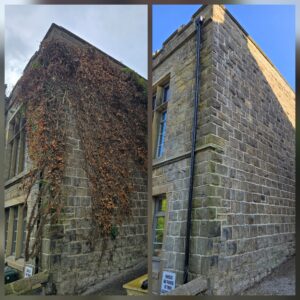
A buyer might imagine that a clear, unmarked brick wall is waiting beneath the plant. In reality, small attachment roots can remain, and the exposed wall may have different colouring, paint wear, weathering or pre-existing defects.
In our sample of 55 recent completed projects, visible attachment marks were recorded after removal in 95% of jobs. That is not a statistic about structural damage; many of these marks were simply cosmetic.
If your plans depend on exposing pristine brickwork, allow for possible cleaning or finishing work. Aggressive scraping or pressure washing is not appropriate for every wall. See our guide to ivy tendrils and remaining attachment marks.
10. A Real Example: Ivy From Next Door in Marple, Stockport
In October 2026 our team attended what initially appeared to be a relatively small ivy-removal job in Marple (SK6). The ivy originated from one property and had spread across the neighbouring building, reaching roof tiles, fascia and other roofline components.
During removal we found heavy woody stems intertwined with deteriorated timber and growing beneath roof tiles. Some tiles had been lifted several centimetres. The guttering had also become displaced.
The work developed into approximately eight hours for three team members, much more than originally expected. We carefully removed the ivy and carried out agreed minor reinstatement, including reseating tiles and securing the affected guttering. Both neighbouring parties were satisfied with the work.
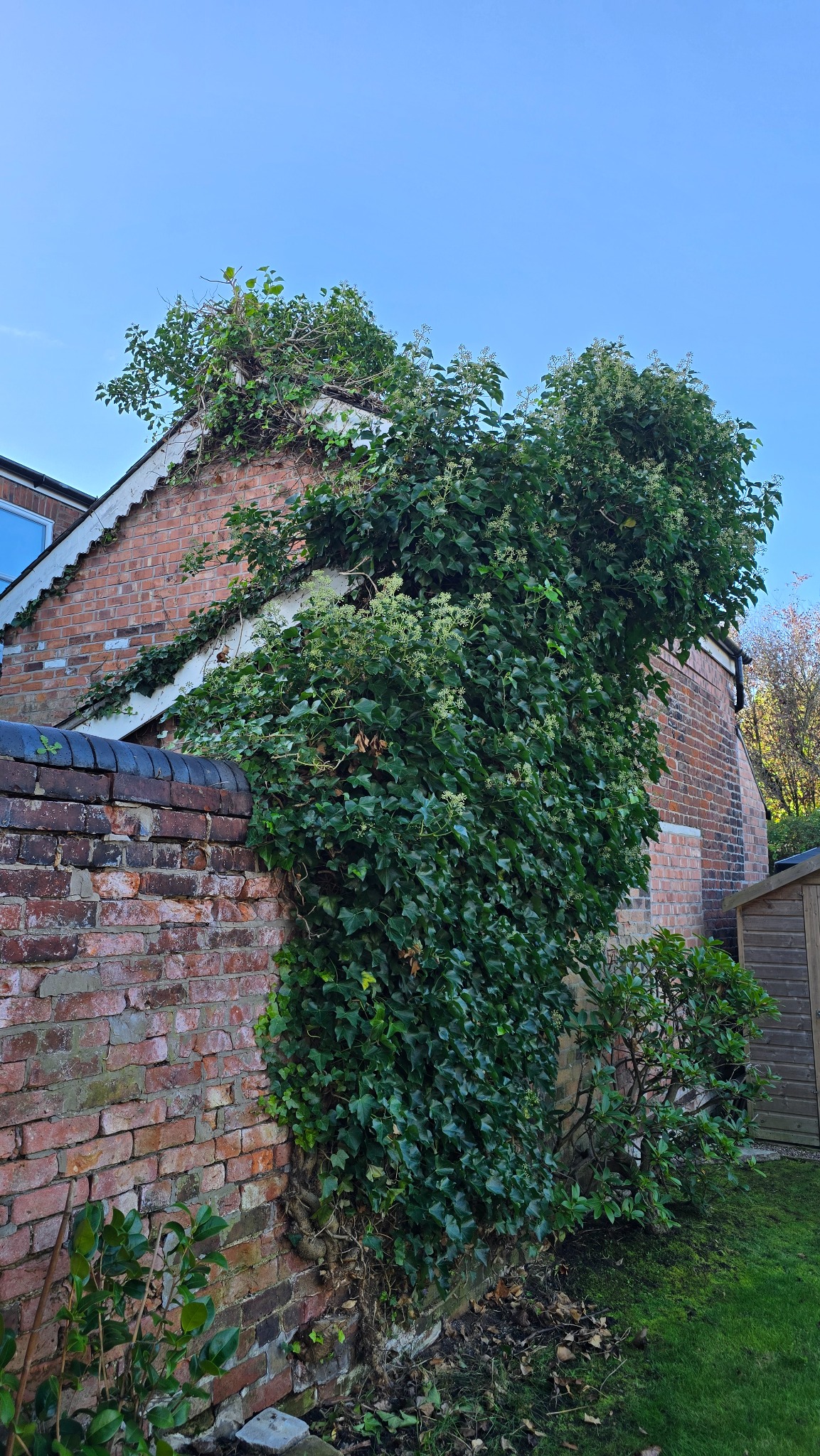
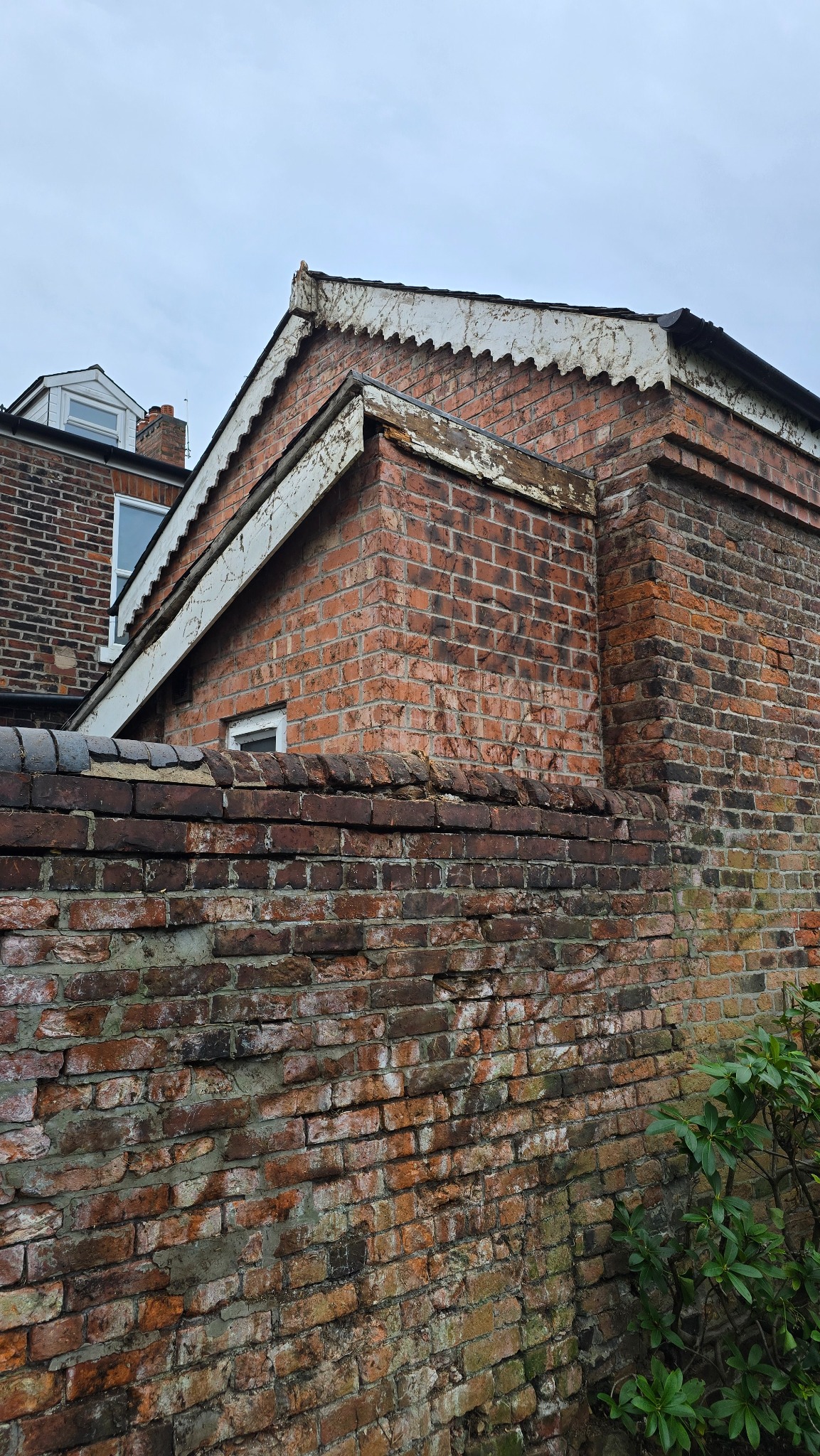
The lesson for buyers: a plant rooted outside your property can still affect your home, and the extent of removal work may not be apparent until the ivy is carefully reduced. Deteriorated timber already present should not be described as damage caused by the clearance.
A separate detailed Marple project case study will be published and linked from this article later.
11. Should You Ask the Seller to Remove the Ivy or Negotiate?
Request information and further inspection
Ask when the growth was last maintained, where it is rooted, whether a neighbour is involved, and if any related repairs have been carried out. If the survey is limited by vegetation, discuss appropriate further checks.
Obtain a removal quotation before exchange
You can often get an initial specialist estimate using photographs and the postcode. Where there are actual building defects, seek separate quotations and advice from the relevant professionals.
Consider keeping it
If the ivy is healthy, manageable and attractive, retaining it may be entirely reasonable. Any negotiation should be based on evidence of condition, costs and uncertainty—not on the assumption that greenery is inherently a defect.
12. Ivy Risk Checklist for Homebuyers: Eight Things to Check
Use this quick comparison when viewing a house or reading its survey. “Higher concern” does not mean the property is unsafe or unsuitable; it means that issue deserves closer attention.
| Check | Lower concern | Higher concern |
|---|---|---|
| 1. Maturity | Thin, manageable stems | Thick, woody, extensive growth |
| 2. Maintenance | Regularly trimmed | Neglected, no clear history |
| 3. Height | Low, readily accessible growth | Several storeys or high roofline |
| 4. Roof and gutters | Roofline and drainage clear | Ivy under tiles, over gutters or vents |
| 5. Walls | Sound-looking, visible masonry | Cracks or large hidden areas |
| 6. Neighbours | Origin and upkeep understood | Rooted next door or crossing boundaries |
| 7. Ongoing upkeep | Realistic, affordable trimming | Uncertain or costly maintenance |
| 8. Removal access | Unobstructed safe access | Conservatories, obstacles or fragile areas |
This practical maintenance checklist is not a structural survey, legal opinion or formal building-risk assessment.
13. Wildlife, Listed Buildings and Other Considerations
Ivy is an important source of shelter and food for wildlife. Before trimming or removal, check for nesting birds, bats and other protected species. Work may need to be postponed or assessed by a qualified ecologist to avoid disturbance.
Extra care is also necessary around listed buildings, scheduled monuments and vulnerable historic masonry. Historic England’s management guidance is a useful reference; seek appropriate conservation advice where relevant.
14. Frequently Asked Questions
Does ivy automatically damage brickwork?
No. Attachment roots generally cling to sound masonry, although ivy can grow into existing gaps, and heavy growth can conceal defects.
Can ivy affect a mortgage or valuation?
Not automatically. If vegetation obscures significant areas or a suspected defect, a valuer or lender may request more information. The decision is property- and lender-specific.
Can I keep ivy on only part of my house?
Often, yes. Partial reduction with regular trimming may keep a suitable area green while protecting windows, vents and roofline features.
What if a neighbour will not maintain their ivy?
First establish where it is rooted and what areas it affects. Seek a practical agreement where possible and legal advice if an actual dispute arises.
Can ivy grow back after removal?
Yes. Live roots or stumps can regrow. Check what root or stump work is included in the quotation and what monitoring may be needed afterwards.
15. Final Verdict: When Is an Ivy-Covered House Worth Buying?
Don’t walk away from an otherwise good home simply because it has ivy. An attractive, maintained covering on sound masonry may be compatible with many years of home ownership.
But if the ivy is mature, hard to reach, rooted next door, or hiding roof and wall details, investigate before becoming legally committed. Think about who owns the plant, how it will be kept under control and what removal or follow-on repairs could cost.
The best decision is based on inspection and practical maintenance arrangements—not fear of the plant itself.
16. Professional Ivy Removal Advice From Trusted Cleanerz Ltd
Trusted Cleanerz Ltd specialises in manual ivy removal from buildings across the UK, including mature roofline growth and ivy crossing neighbouring properties. If you are considering buying an ivy-covered house, we can often provide an initial removal quotation from photographs and property details.
We are not building surveyors, but we can explain the likely scope of vegetation removal, access considerations and potential areas needing separate trade assessments.
UK Ivy Removal ServicesRequest a QuoteOur Research ReportResearch note: percentages quoted refer to a sample of 55 recent Trusted Cleanerz removal projects and should not be generalised to all UK houses. This is general property-maintenance information, not a substitute for a qualified surveyor or conveyancer.