How Deep Are Ivy Roots? Root Depth, Real Photos & Regrowth
How deep do ivy roots go? Common or English ivy (Hedera helix) usually has a shallow root system, but there is no single depth that applies to every plant. A field observation cited by the US Forest Service recorded roots approximately 3–10.5 cm beneath the soil surface. This is one observation, not a maximum depth for every garden.
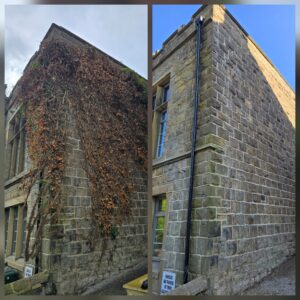
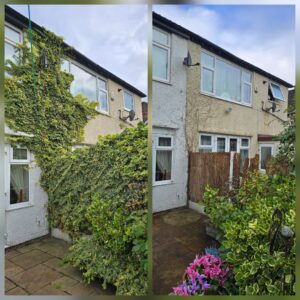
In our UK ivy-removal work, we often find the main difficulty is not how far down the roots go, but how far the plant has spread at ground level. Woody root crowns and creeping stems that have rooted into the soil can make established ivy difficult to remove — and living stems or stumps can produce fresh growth if left behind.
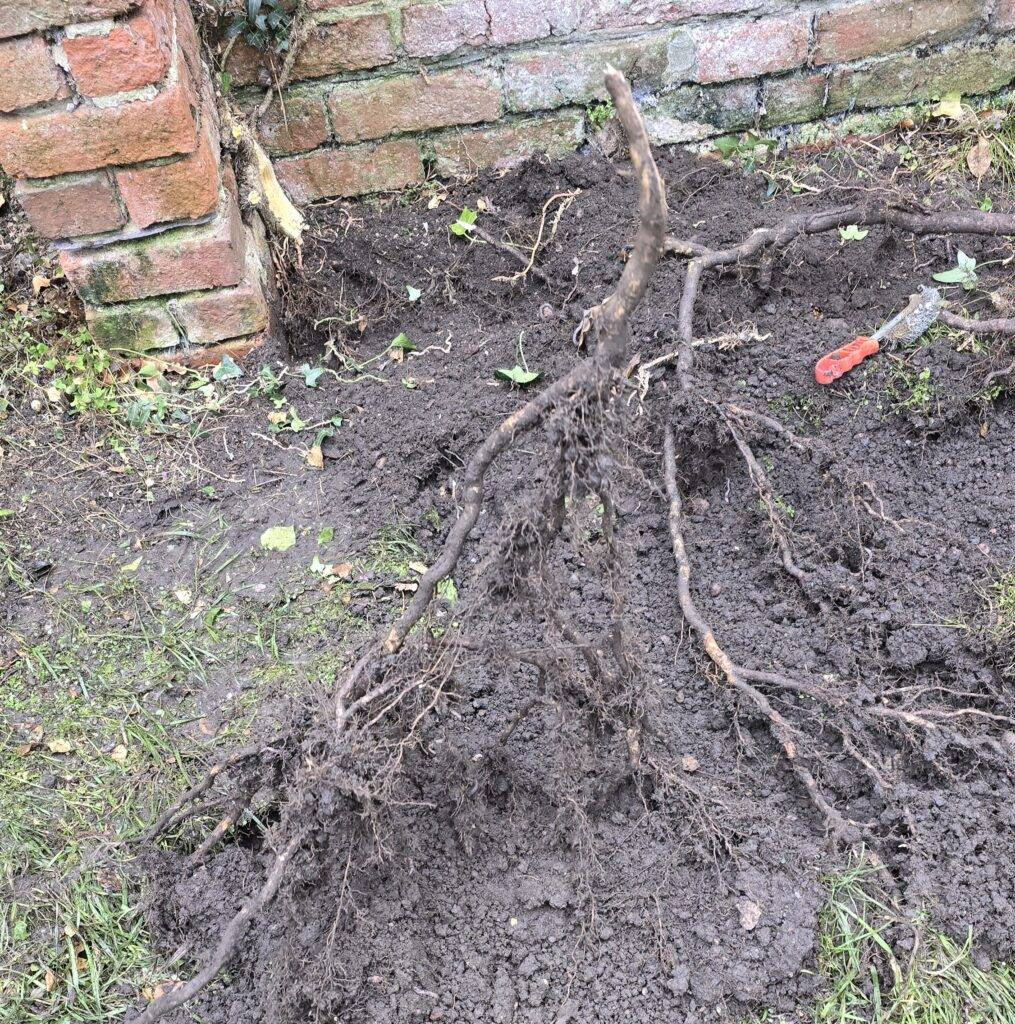
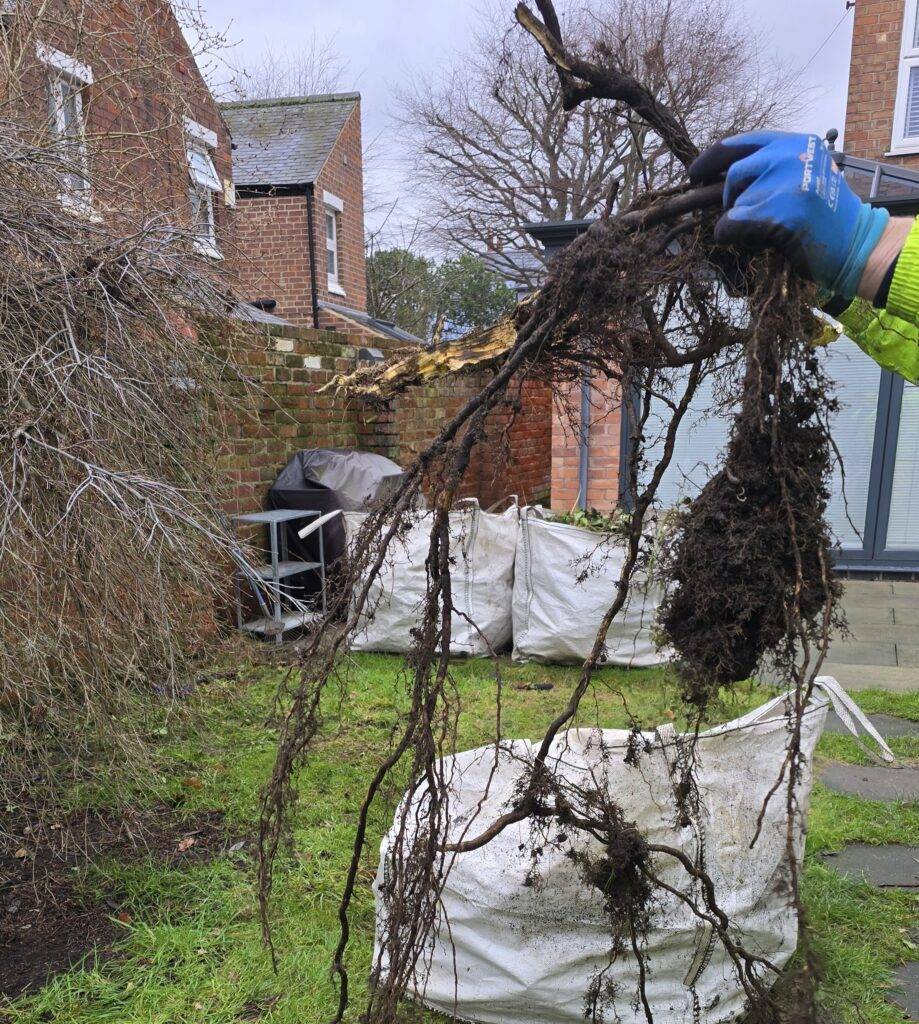
This job is a perfect example. From the outside it looked like a fairly small ivy issue around the base of a brick wall — but once we opened the soil up, the root system was much larger than expected, with thick runners spreading out under the surface.
In this post we’ll show you what ivy roots typically look like once exposed (using photos from a recent job), explain how deep ivy roots normally go, and what that means for preventing regrowth.
How Deep Do Ivy Roots Go? What the Research Says
English ivy is generally shallow-rooted rather than having a deep taproot. The US Forest Service’s review of published research reports an observed root depth of 3–10.5 cm in Washington, DC; other research described shallow rooting in English ivy. These figures are useful examples, not a universal digging depth. Root depth varies with the plant’s age, soil, moisture and growing conditions. On our own jobs, we regularly expose substantial woody crowns and rooted stems close to the surface.
What surprises many homeowners is not the depth but the spread. Creeping ivy stems can travel over loose soil, borders and turf edges and form new roots where they contact suitable ground. This means the visible climbing stem may be connected to more than one rooted section.
What ivy “roots” are we actually talking about?
Here, “ivy” means common or English ivy (Hedera helix), not Boston ivy or North American poison ivy. There are two root types that people often confuse:
1) Underground roots (the ones that feed the plant)
These roots grow in soil and absorb water and nutrients. Ivy can regrow from a living root crown, stump or stem that has rooted into the ground. Simply leaving a detached root fragment does not necessarily mean a new plant will grow.
2) Aerial attachment roots on walls (not tendrils)
These tiny aerial rootlets act as anchors, helping ivy cling to brick, stone, render, timber and fences. They are different from the feeding roots underground, and ivy does not climb by tendrils. The Royal Horticultural Society explains that aerial roots cannot bore into sound masonry, although growth may exploit existing cracks and weakened joints.
If you want a dedicated guide on cleaning up the wall “grip” after removal, this post is useful:
https://trustedcleanerz.com/remove-ivy-tendrils/
Real job example — a “small” ivy issue with a surprisingly large root system
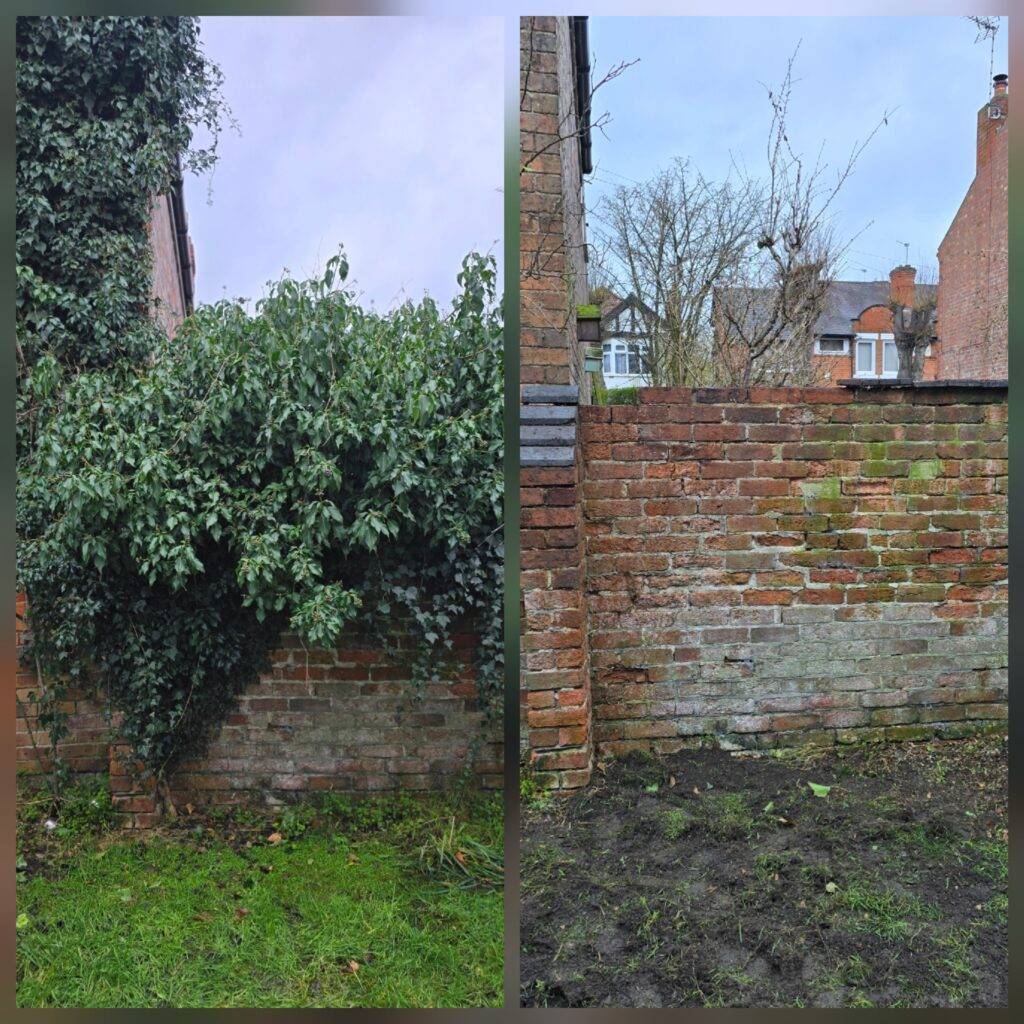
On this job, ivy had taken over part of a brick wall and the base area. From a distance, it didn’t look like a major problem — just a moderate patch of ivy.
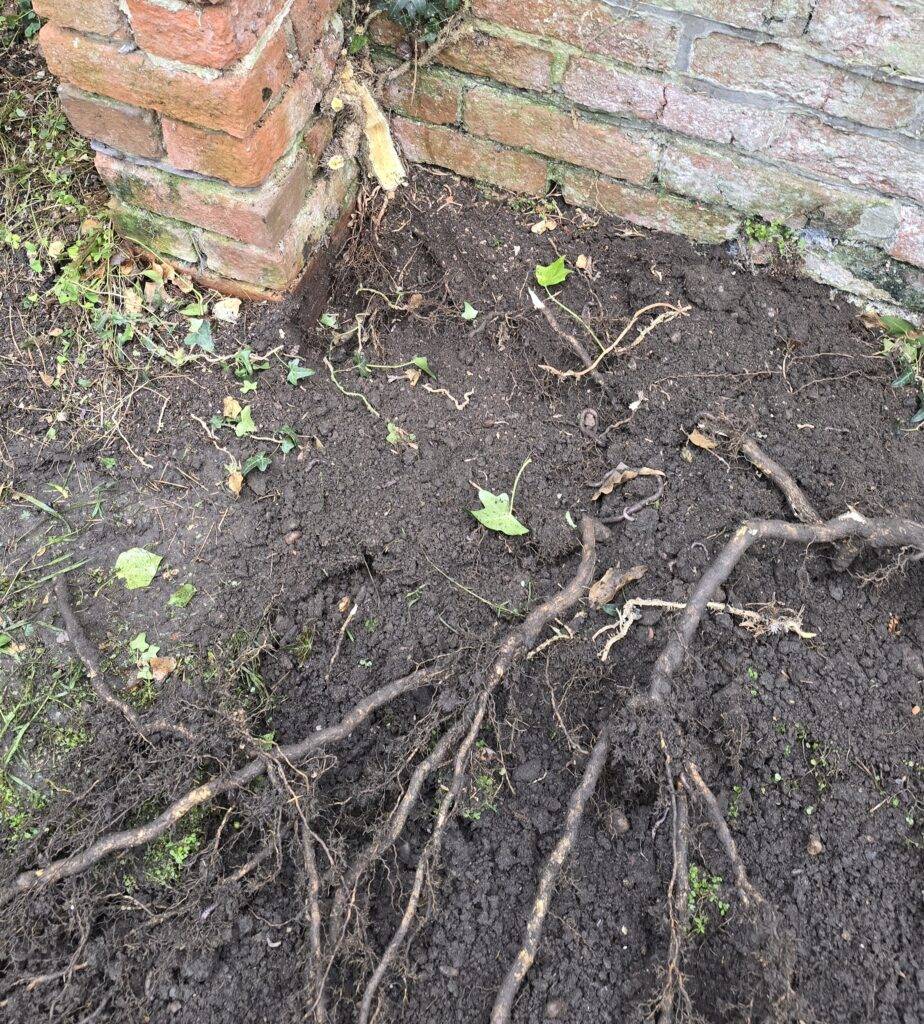
But once we cleared the growth and started digging, we found:
- the main roots were close to the surface
- the system spread outwards rather than going straight down
- there were multiple thick runners feeding into a larger root mass
This is common with ivy. The visible growth doesn’t always reflect what’s happening underground. You can have a relatively small amount of ivy showing above ground, but a well-established network of roots and runners below the surface.
What that means for homeowners
If you only clear the ivy from a wall but leave the living stump, root crown or rooted ground-level stems in place, fresh shoots may grow. Removing the top growth alone does not reliably prevent regrowth.
Why ivy doesn’t usually need deep roots
Ivy is very efficient at surviving because:
- it can thrive in shade and use moisture held in surface soil
- it spreads laterally and finds multiple feeding points
- it climbs walls for light rather than relying on deep water access
So instead of digging deep, the plant often wins by spreading wide.
How to check how far ivy roots go (simple homeowner method)
If you’re investigating ivy at the base of a wall, a little careful digging may reveal the rooted stems and stump. Wear gloves and avoid digging near unknown cables, pipes, drains or vulnerable foundations. Do not excavate deeply beside a wall without appropriate advice.
Step-by-step
- Find the main stem(s) where ivy meets the ground
- Pull back loose soil carefully with a hand trowel
- Look for thick runners heading left/right under the surface
- Follow them gently — you’ll often find they run sideways just under turf or border soil
If you start finding thick, woody runners disappearing under patios, fences, or into established planting beds, that’s when a job can become more involved.
How to stop ivy growing back (without turning your garden into a crater)
You don’t normally need to excavate half the garden. The goal is to remove or properly deal with the parts most likely to regrow.
Focus on
the main root crown / stump at the base
the thick shallow runners close to the wall
any secondary stems that feed into the main base area
Then monitor
Even after a thorough removal, keep an eye on the base area for a few months. If shoots appear, deal with them quickly before they re-establish.
What about removing ivy from brickwork?
We won’t go deep into “methods debates” here, but the key practical point is this:
Ivy’s aerial rootlets generally do not penetrate sound masonry, but they can exploit existing cracks and loose pointing. Forcefully pulling ivy away can also dislodge weak mortar, paint or fragile surfaces. Historic England advises careful, controlled removal rather than tugging at large sections.
A few sensible tips
- work in small sections
- keep tension controlled and shallow (peel away rather than yank out)
- once growth is removed, address the remaining wall residue/tendrils carefully
If you’re wondering when ivy becomes urgent (risk to gutters, rooflines, weak pointing, or damp issues), this guide is helpful:
https://trustedcleanerz.com/when-ivy-should-be-removed-immediately/
And for the bigger picture of ivy and property, here’s another useful reference:
https://trustedcleanerz.com/is-ivy-good-or-bad-for-your-home/
FAQ — ivy roots and regrowth
Do ivy roots damage foundations?
English ivy normally has relatively shallow underground roots, and its aerial rootlets cannot bore through sound masonry. However, ivy can exploit existing gaps and defects, and the RHS notes that large mature ivy close to an older house with shallow foundations on clay soil could contribute to subsidence risk. If there are significant cracks or movement, have the building professionally assessed rather than assuming the ivy is harmless or solely responsible.
Will ivy grow back if I remove the visible plant?
Yes. Ivy can send out new shoots from a living root crown, stump or rooted stem after the climbing growth is removed. Digging out the stump where practical and checking for regrowth helps prevent re-establishment. The RHS recommends removing the stump where possible or repeatedly cutting new growth.
How wide can ivy roots spread?
Often wider than people expect. Ivy commonly spreads laterally through the topsoil, especially where soil is loose and shaded.
Is ivy removal messy?
Yes — particularly once you start exposing the shallow runners and soil around the base. The underground part is often the most surprising stage because the root network can be much bigger than it looks from above.
Professional Ivy Removal and UK Prices
If ivy is covering brickwork, growing into gutters, or you’re seeing regrowth from the base, we can help with safe removal and tidy clearance.
Start here:
https://trustedcleanerz.com/ivy-removal/
Or if you’re pricing up the job, this guide gives typical UK cost context:
https://trustedcleanerz.com/ivy-removal-cost-uk/
Request an Ivy Removal Quote
If your ivy keeps growing back or you’ve uncovered a large root system near brickwork, we can help.
Get a quote here: https://trustedcleanerz.com/contact/