Why Cutting Ivy at the Base and Leaving It Is Not the Best Way to Remove Wall Ivy
A lot of homeowners assume that once ivy has been cut at the base and left to dry out, the hard part is over. The thinking is simple: once it is dead, it should be easy to pull off the wall.
In reality, that is often not what happens.
When ivy has been attached to a wall for a long time, dead growth can still be extremely firmly bonded to the surface. Instead of peeling away in large sections, it can snap, crumble, and break off bit by bit. What looks like a quick job can turn into hours of difficult removal.
That is why cutting ivy at the base and coming back later is not always the best way to remove ivy from a wall.
Why so many people think dead ivy will pull off easily
This idea is everywhere online. Many people search for the best way to remove ivy from brickwork or the best way to remove dead ivy from a wall, and they keep seeing the same simple advice: cut the stems, let the ivy die, then pull it away later.
The problem is that this advice can be too simplified for wall ivy.
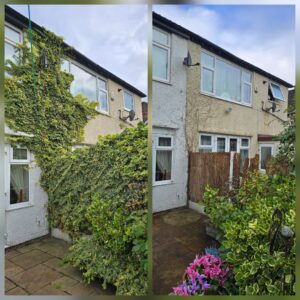
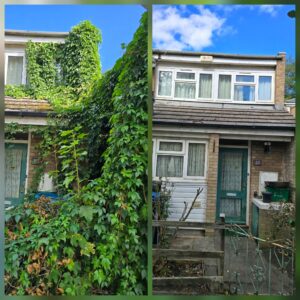
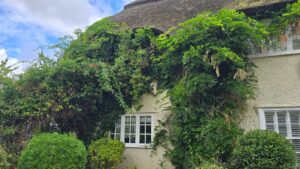
It may sound logical, but dead ivy is not always loose ivy. Once mature ivy has spread across brickwork, render, mortar, pipes, fixtures, and edges around windows, it can remain strongly attached even after it has dried out.
So while cutting ivy at the base may stop further growth, it does not guarantee that later removal will be quick or easy.
The problem with “cut it and leave it” wall ivy advice
The biggest issue with this advice is that it creates the wrong expectation.
People hear “leave it to die” and assume that the dead ivy will then just pull away from the wall without much effort. On real jobs, that is often not the case. In many situations, the ivy still clings tightly to the surface and breaks away inch by inch instead of releasing cleanly.
That means the job people expect to take a few minutes can become long, slow, awkward work.
This is especially true when ivy has been on the wall for years and has spread around features such as windows, dishes, cables, corners, and joints in the wall. In those cases, removing dead ivy from brickwork is often much harder than people think.
Why wall ivy behaves differently from ivy on trees
Part of the confusion comes from the fact that advice about ivy on trees often gets mixed together with advice about ivy on walls.
Wall ivy is different. It spreads across a fixed surface and grips across a much wider area than most people realise. Over time, it works itself around wall details and property features, which means removal is rarely just a case of pulling it downward.
Once that bond is established, dead ivy can still stay attached very firmly. That is why the best way to remove ivy from a wall is not always the same as general ivy-control advice you might see elsewhere.
For many properties, the real challenge is not killing the ivy. It is removing what is left behind.
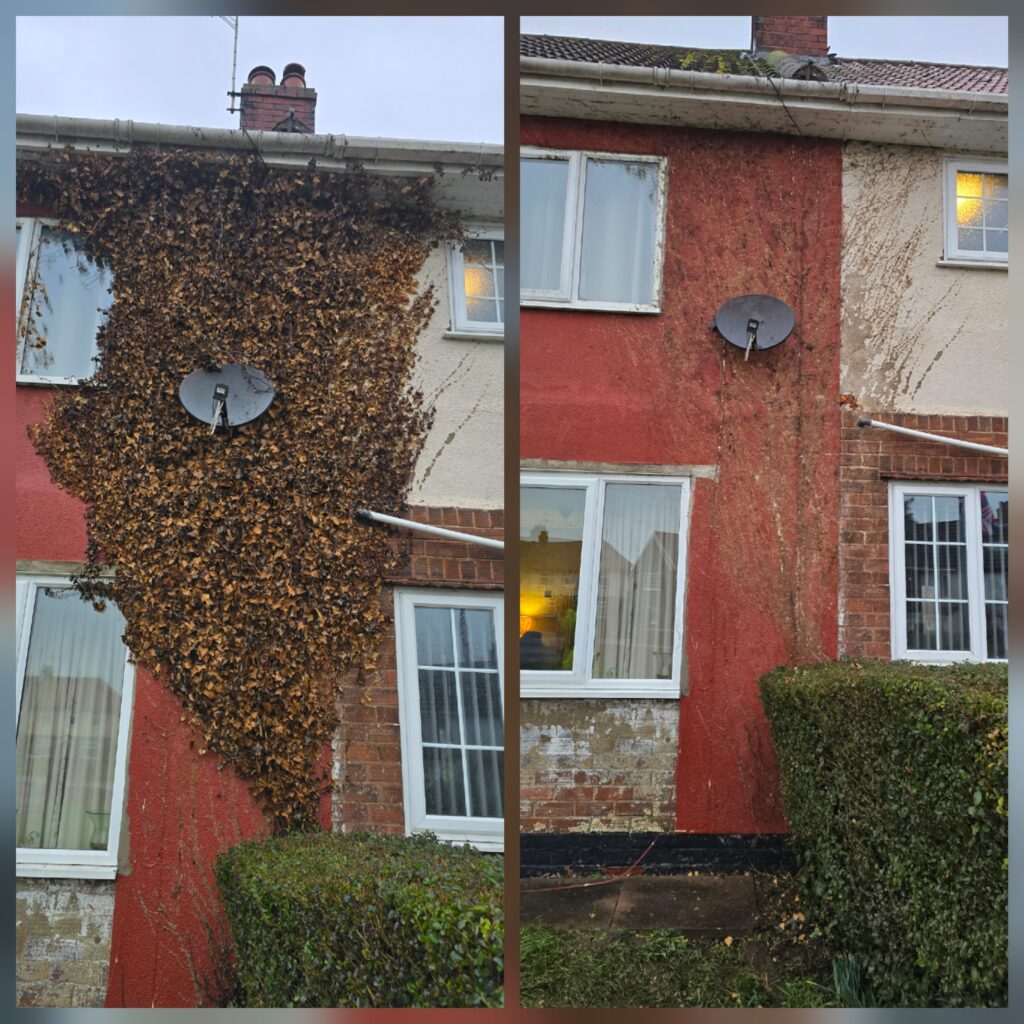
Worksop case study: what looked like a 10-minute job became a 6-hour removal
We saw this clearly on a recent job in Worksop.
The customer had already cut the ivy at the base and thought the rest would simply pull away from the wall. Because the ivy had dried out, she expected the whole thing to be off in around 10 to 15 minutes.
At first glance, that seemed understandable. The ivy looked dead, dry, and ready to come away.
Even one of our operators, who was newer and still in training, initially thought the same. The expectation was that this would be a very quick pull-off job.
But once the work started, the reality was completely different.
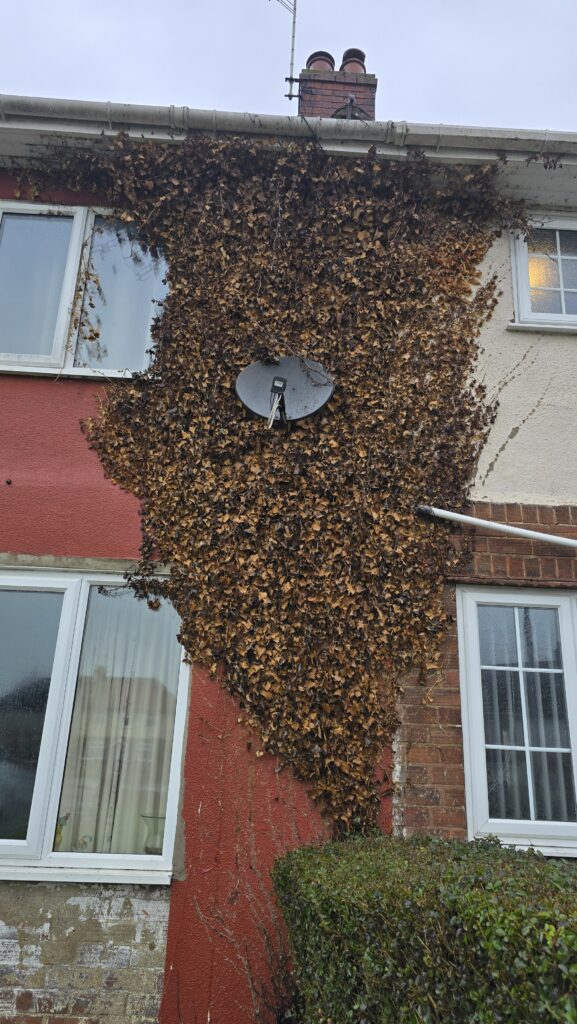
The ivy was still extremely strongly bonded to the wall. Instead of peeling away easily, it kept breaking off inch by inch. The bond was so strong that what looked like a short job ended up taking two experienced operators around six hours of actual work to complete.
That is exactly why “cut it and leave it” is not the best default advice for wall ivy. Dry ivy can still be very hard to remove.
Why this customer wanted the ivy removed
This job was not only about appearance.
The customer wanted the ivy removed because it had started causing practical problems around the property. It had spread onto the neighbour’s side, which made the issue more urgent. It had also covered the satellite dish, causing signal loss, and it was beginning to spread across the window as well.
That is how ivy often becomes a real problem. It may be left alone for years, but once it starts affecting access, light, visibility, fixtures, or neighbouring property, removal becomes much more important.
Issues like that are also why pages such as neighbour’s ivy growing onto your house matter to homeowners. What starts as ivy on one wall can quickly affect much more than the person first expected.
Why the ivy kept breaking off inch by inch
The key issue on this Worksop job was bond strength.
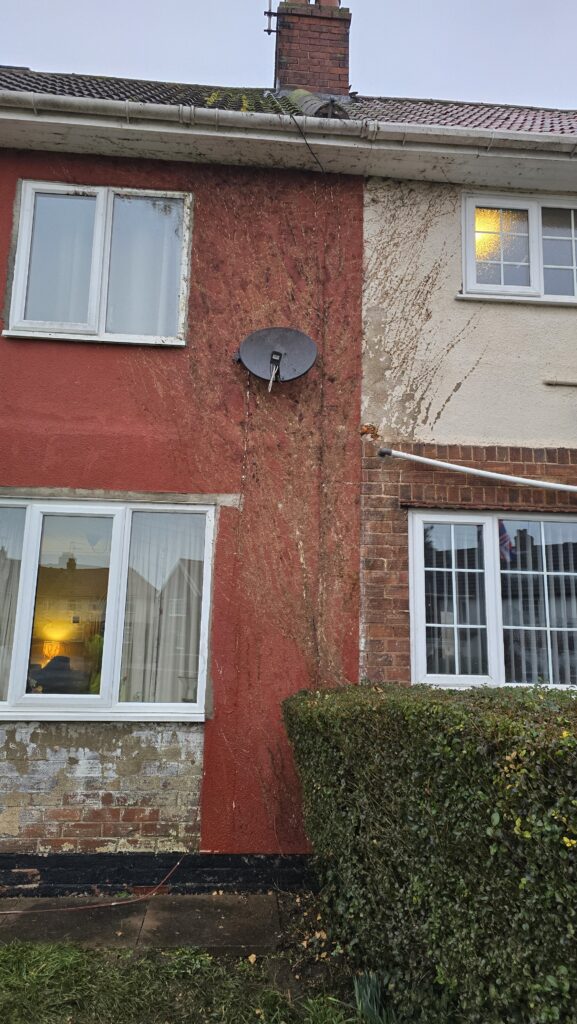
The ivy may have been dead, but it was not loose. It had attached so firmly to the wall that it would not come away cleanly. Instead, it snapped and broke apart continuously during removal, which made the process much slower.
This is one of the main reasons dead ivy can be deceptive. From the ground, it may look like the growth will peel off in sheets. But once you start working on it, the real condition becomes obvious. In some cases, removing dead ivy from a wall turns into detailed, repetitive, inch-by-inch work.
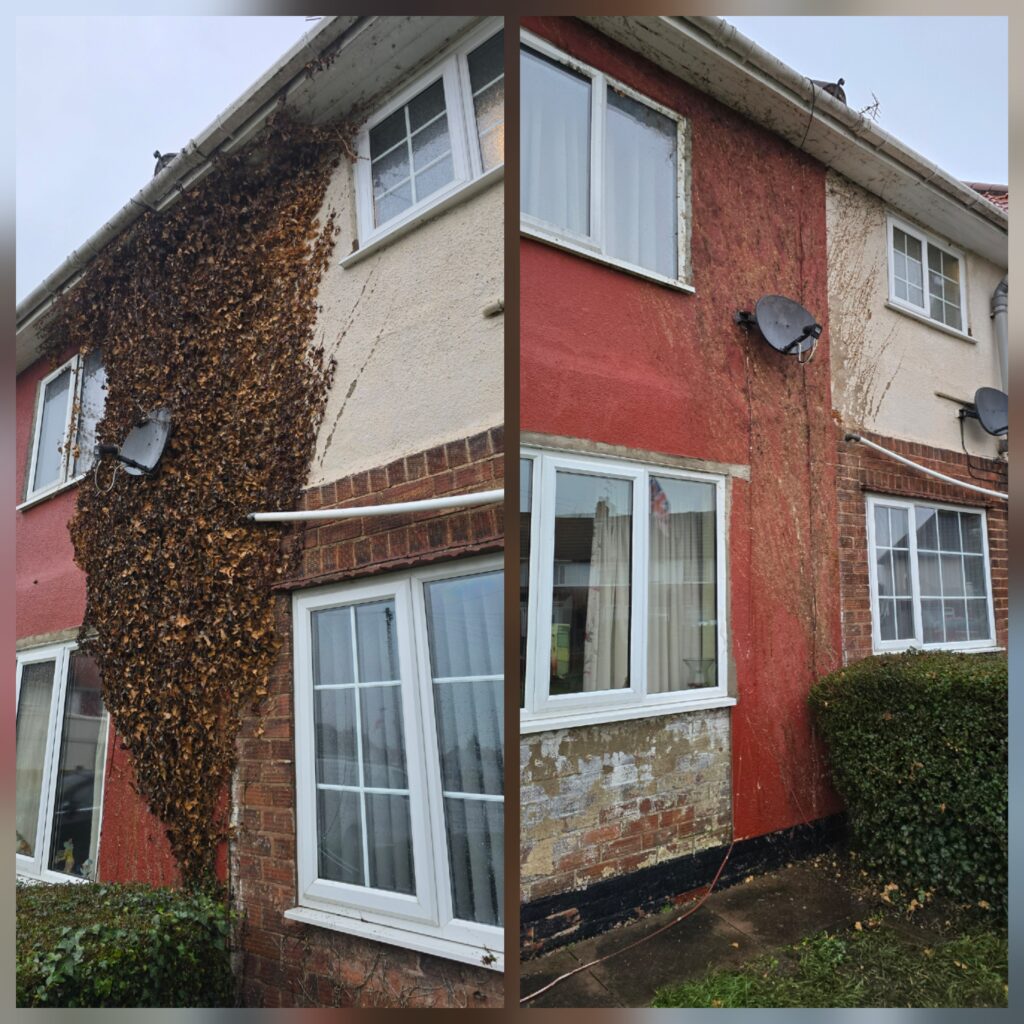
That is also why the final result after ivy removal does not always look perfectly clean straight away. Mature ivy can leave marks, traces, and visible signs of how strongly it was attached. Honest before and after ivy removal photos often show this much better than simplified online advice.
What homeowners often underestimate about dead ivy
The main thing people underestimate is time.
Many assume that once the ivy has died, removal will be quick. But on wall jobs, the opposite is often true. The ivy may no longer be growing, but it can still be stubbornly fixed to the surface.
That changes the whole job. What seemed like a quick pull-off can become a much longer labour job, especially where the ivy has spread widely or wrapped itself around fixtures and edges.
This is one reason why professional ivy removal service work is often underestimated before removal begins.
It is also why people should not assume every job will cost the same. Labour time, access, and attachment strength can all make a big difference, which is why it helps to understand typical UK ivy removal costs before assuming the job is simple.
Why careful staged removal is usually the better approach
The better way to look at wall ivy is not to assume that dead ivy will automatically come away easily.
A more realistic approach is to assess the spread, the surface, the access, the fixtures involved, and how strongly the ivy is attached before deciding how easy the job will be. That usually gives a far more accurate idea of what removal will actually involve.
For wall ivy, the difficulty is often in the attachment, not just in the growth itself.
That is why careful staged removal is usually a better mindset than assuming that cutting ivy at the base has solved the hard part. On many jobs, it has not. It has only changed the type of work involved.
For homeowners in South Yorkshire and nearby areas, local examples such as https://trustedcleanerz.com/ivy-removal-sheffield/ can also help show how ivy removal jobs vary depending on property type, access, and spread.
Final answer: is cutting ivy and leaving it the best way to remove wall ivy?
No, not as a general rule.
Cutting ivy at the base may stop further growth, but it does not mean the remaining ivy will be easy to pull off later. Dead ivy can still be extremely strongly bonded to brickwork and other wall surfaces, and many jobs take much longer than expected because of that.
The Worksop S81 job is a clear example. The customer expected a 10 to 15 minute job. A newer operator initially thought the same. In reality, the ivy was bonded so strongly that it took two experienced operators six hours to remove it.
So if you are wondering about the best way to remove ivy from a wall, the safest answer is this: do not assume that dead ivy will come away easily just because it has dried out.
Contact Trusted Cleanerz
If you need help with wall ivy that is spreading toward a neighbour’s property, covering windows, blocking fixtures, or becoming difficult to remove, get in touch with Trusted Cleanerz.
Phone / WhatsApp: 07858424693
Email: sales@trustedcleanerz.com