Fence Ivy vs House Ivy: What Makes Ivy Removal Difficult?
Ivy covering a house and ivy covering a boundary fence can look like two versions of the same job. In practice, they can be difficult for completely different reasons.
After completing more than 55 ivy-removal projects across the UK, we have repeatedly found that the visible size of the ivy does not always tell you how labour-intensive the removal will be.
A tall house wall may involve working at height, difficult ladder positioning, hidden cables and delicate roofline work. A much lower fence or boundary wall can sometimes be just as time-consuming because the ivy is growing through both sides, rooted in several places and tangled through an old structure the homeowner wants to preserve.
The main difference we see is this: house-wall ivy is often made difficult by height, access and building features, while fence and boundary ivy is often made difficult by entanglement, repeated rooting and the need to preserve the structure.
This article explains the differences using observations from our own ivy-removal work rather than treating every ivy-covered property as the same type of job.
Why house-wall ivy can be difficult to remove
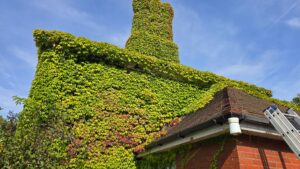
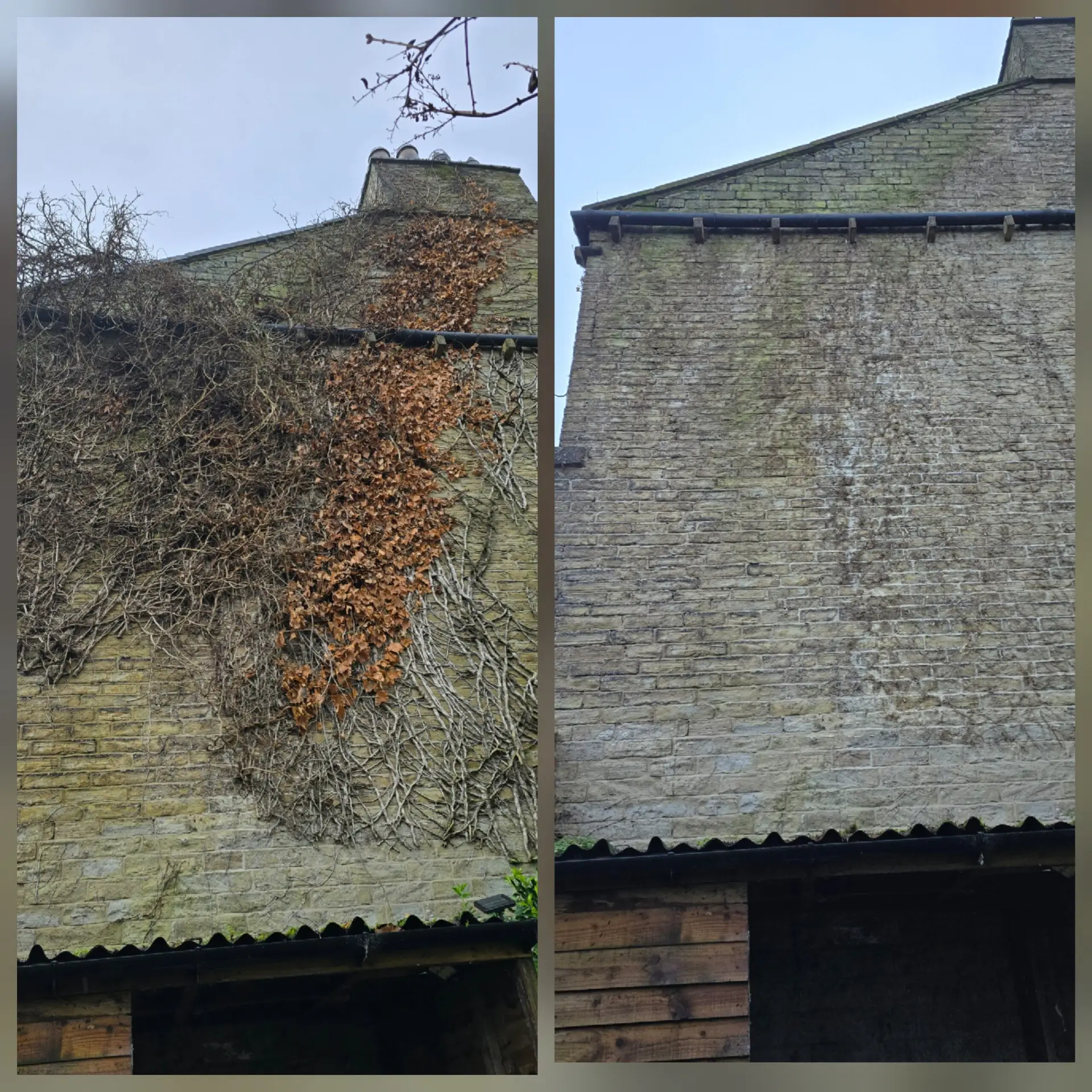
When ivy grows vertically up a house, there is often one dominant stem, or a relatively small number of substantial stems, starting near ground level and spreading upwards across the elevation.
That might sound simpler than ivy spread along a boundary, but once the plant reaches upper-storey windows, gutters, soffits and the roofline, the nature of the work changes considerably.
1. Working at height slows the job down
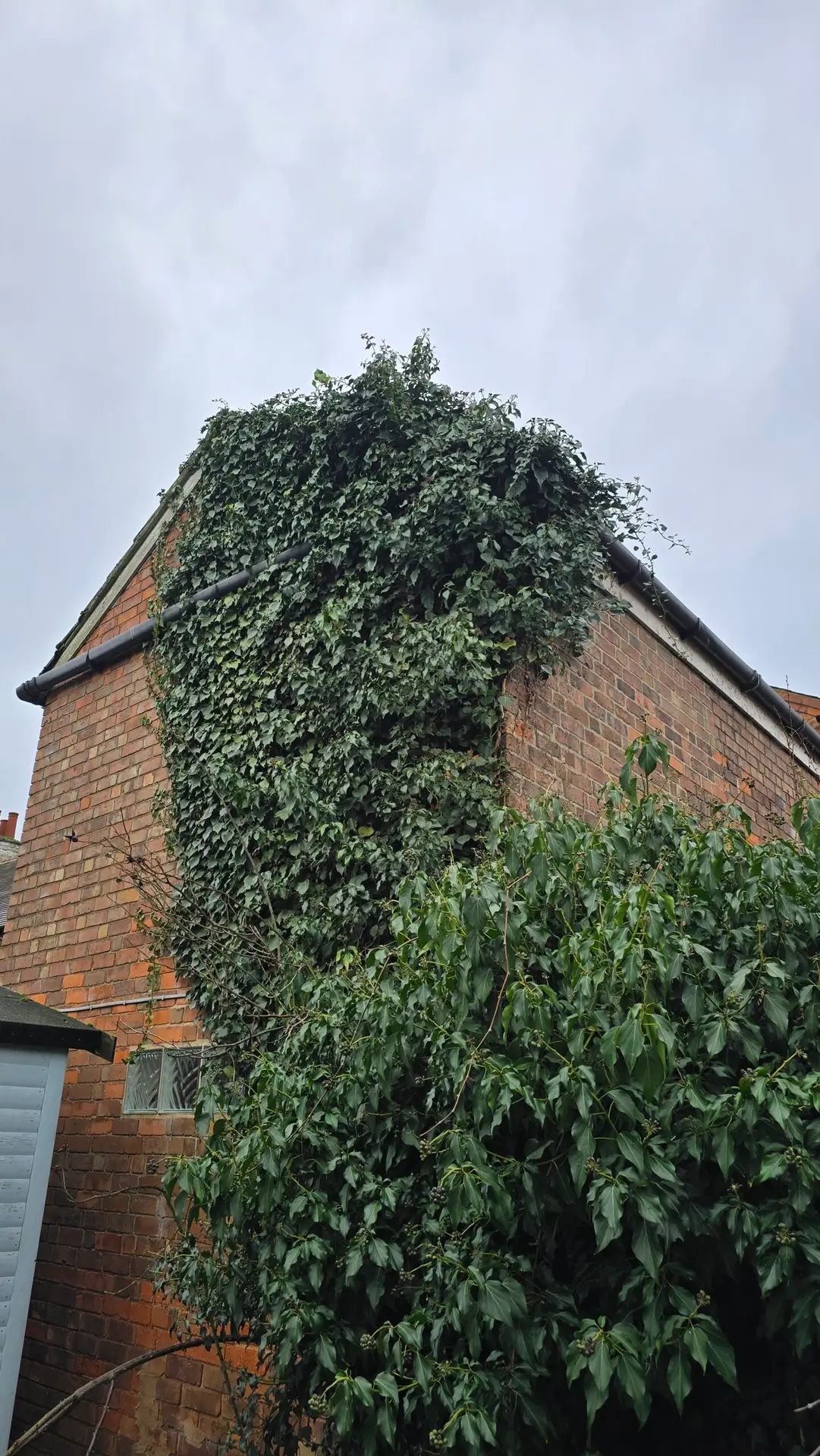
The higher the ivy grows, the more carefully the work has to be organised. Removal from upper-storey walls cannot be approached in the same way as cutting vegetation at ground level.
Ladders need to be positioned securely, the work area has to be reached safely, and the ivy is normally reduced in controlled sections. The team may have to reposition repeatedly as different parts of the wall become accessible.
This means a section that could be cleared quickly at ground level can take much longer several metres above the ground.
2. Dense ivy can hide what is underneath
One of the biggest difficulties with heavy house-wall ivy is that the surface behind it may be almost completely invisible before removal starts.
There can be internet or telephone cables, aerial cables, external wiring, gas pipework, downpipes, vents, brackets, lights and other fittings hidden behind the growth.
In extreme cases, even the edges of windows can be difficult to see through very dense ivy.
This is one reason heavy wall ivy should be opened up progressively. Large sections cannot simply be cut and pulled away without first understanding what the plant has grown around.
3. Ladder positioning is not always straightforward
A photograph of a wall can make access look much easier than it really is.
The ground directly below the ivy may contain shrubs, planted borders, stones, uneven surfaces, stored materials or building materials from other work taking place at the property.
There may also be an extension, conservatory, garage or other structure underneath the section that needs to be reached.
If the ladder cannot be placed in the ideal position directly below the work area, the team may need to reposition more frequently or approach the removal from a different direction.
4. Conservatories can make roofline access particularly difficult
A common difficulty is ivy growing above a conservatory.
The plant may already have reached the gutters, soffits or lower roof tiles, but the conservatory below prevents straightforward ladder positioning from ground level.
This can turn what looks like a normal section of house-wall ivy into a considerably more difficult access job.
The roofline is often the hardest part of house-wall ivy removal
From our experience, the area around the gutters and roofline is frequently the slowest and most delicate part of a mature house-wall ivy job.
Ivy can wrap around guttering, weave around gutter brackets, spread behind fascia or soffit areas and sometimes grow beneath the edges of roof tiles.
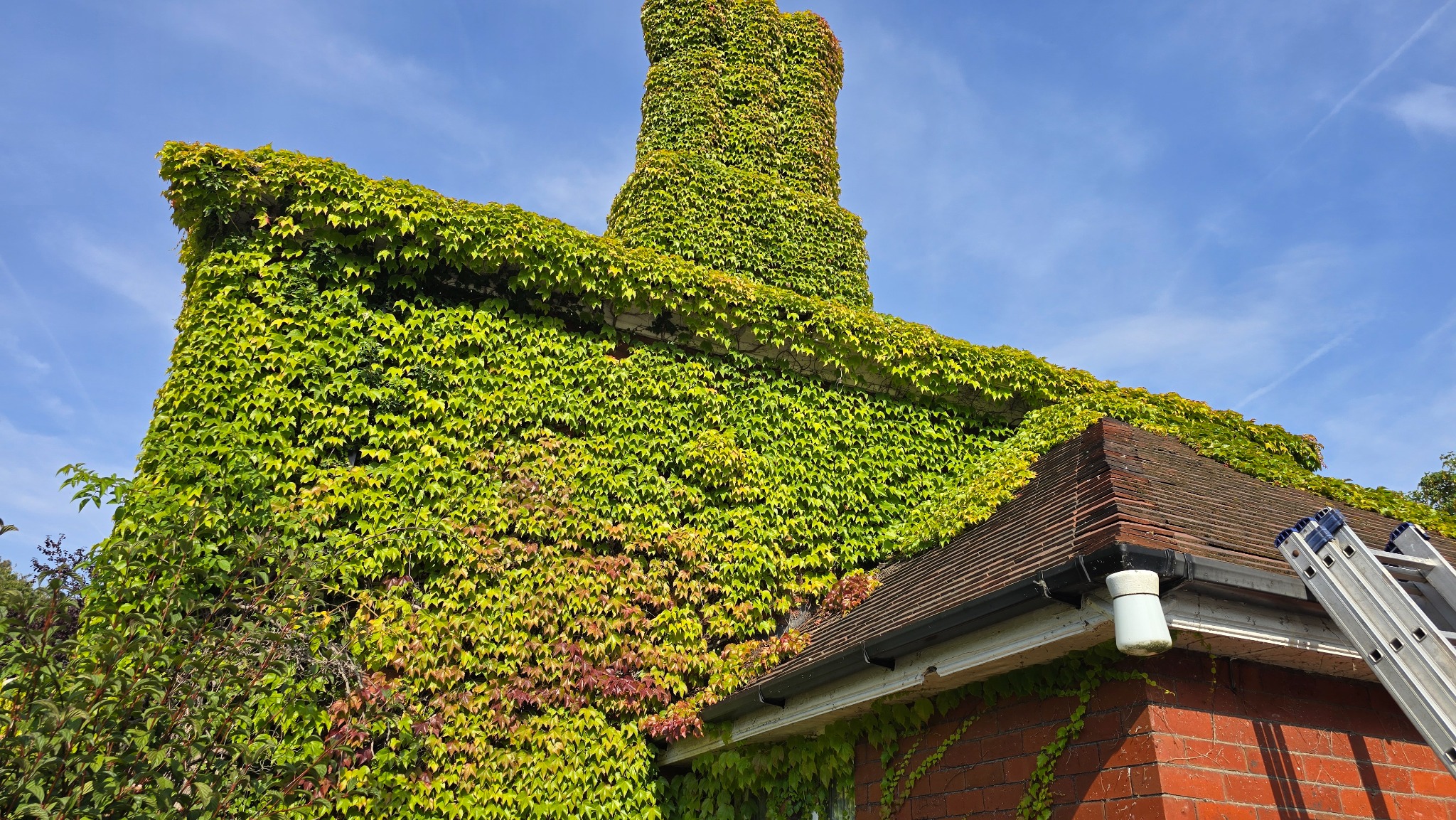
At that stage, speed is not the priority.
The growth has to be separated carefully so that gutters, brackets, soffits and tiles are not unnecessarily damaged during removal.
Large sections cannot simply be pulled down when the ivy is attached around multiple building components.
5. Wind and weather matter much more when working at height
Weather can also affect whether a high-level ivy job can safely proceed.
Strong or gusty winds can make prolonged ladder work unsafe, particularly around rooflines and building corners where wind behaviour can be unpredictable.
This means some house-wall removals may need to be postponed even when lower-level vegetation work would otherwise be possible.
Why fence and boundary ivy creates a different problem
Fence ivy is lower to the ground, so homeowners sometimes assume it should be easier.
That is not always the case.
Boundary ivy can be extremely labour-intensive because the plant often behaves differently from ivy climbing a straightforward house elevation.
6. Boundary ivy is often rooted in several places
On a house wall, there is often one main stem or a small number of main stems rising from the base of the building.
Along a boundary, we often encounter a different growth pattern.
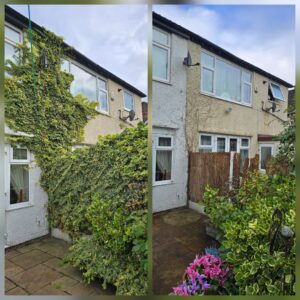
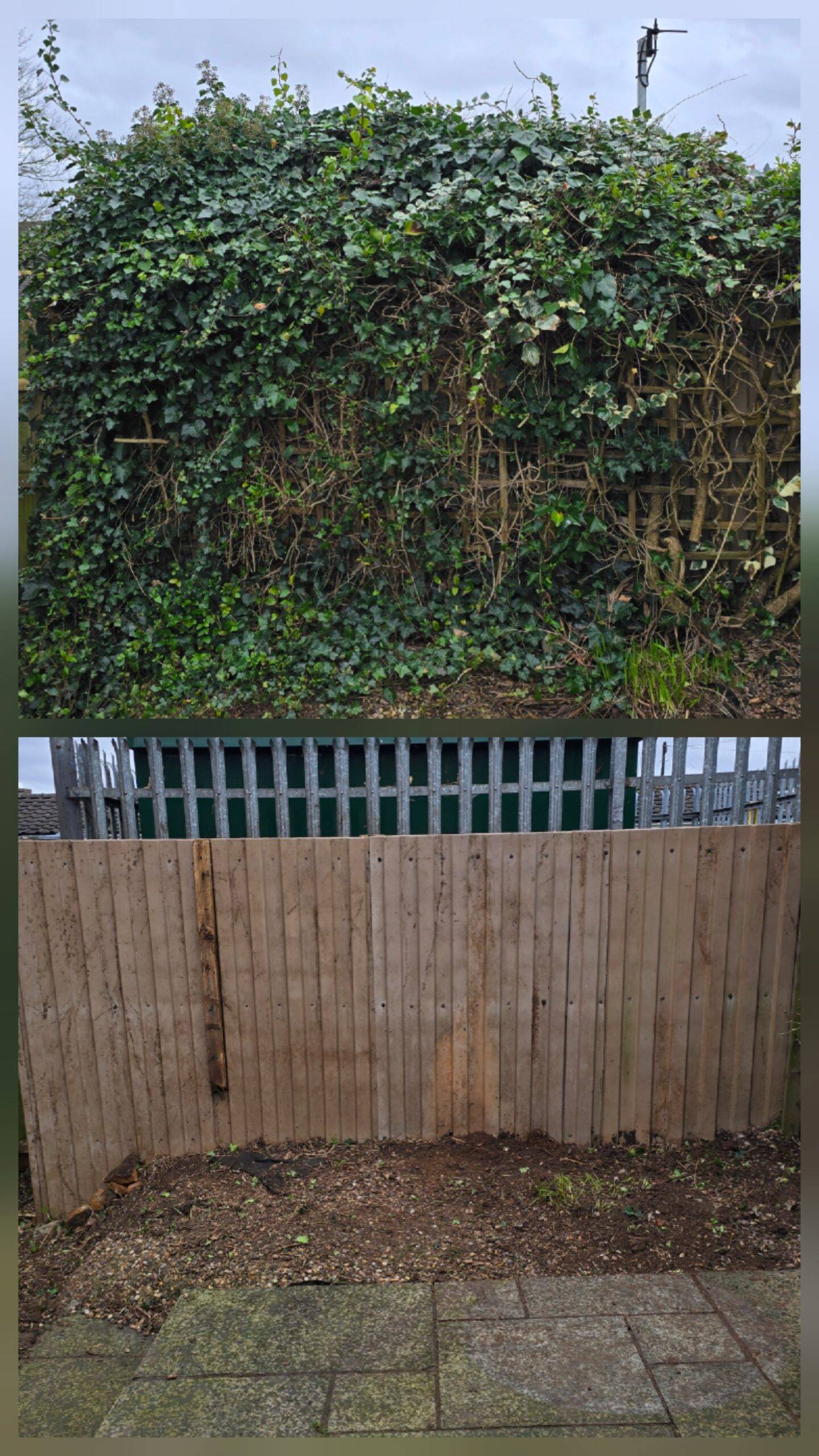
Ivy can be rooted at several points along the fence line. It may grow upward, travel along the top of the fence, drop down the opposite side and establish again nearer the ground.
Over time, this can create an interconnected mass rather than one easily identifiable stem.
Cutting one obvious stem may therefore not disconnect the entire plant. Several sections may need to be traced, separated and cut individually along the boundary.
7. Ivy often grows through both sides of a fence
Mature ivy does not simply sit on the face of a wooden fence panel.
It can pass between slats, around posts and rails and through gaps before spreading across the other side.
That frequently means proper removal requires access from both sides of the boundary.
One side may be cleared only to reveal further stems tightly interwoven through the reverse side.
8. Old fence panels often need to be preserved
Another complication is the condition of the fence itself.
By the time ivy has become badly overgrown, wooden boundary panels may already be old, weathered or weakened.
However, homeowners often still want the existing fence preserved, at least temporarily, until replacement panels can be purchased and fitted.
That means the removal has to be carried out very carefully.
Aggressively pulling large masses of ivy from a fragile panel can crack timber, loosen rails or cause an already weakened section to collapse.
Stems may instead need to be cut and separated progressively from the timber.
This is one reason a relatively low fence job can take considerably longer than somebody might expect from the photographs alone.
Stone boundary walls can be even more labour-intensive
Stone walls create another type of difficulty.
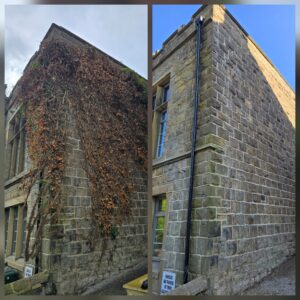
Ivy can grow into gaps between individual stones, around irregular surfaces and through cavities within the wall.
Instead of peeling one large section from a flat surface, the team may need to cut and extract numerous smaller sections individually.
Growth may also continue along ground level and through vegetation beside the wall.
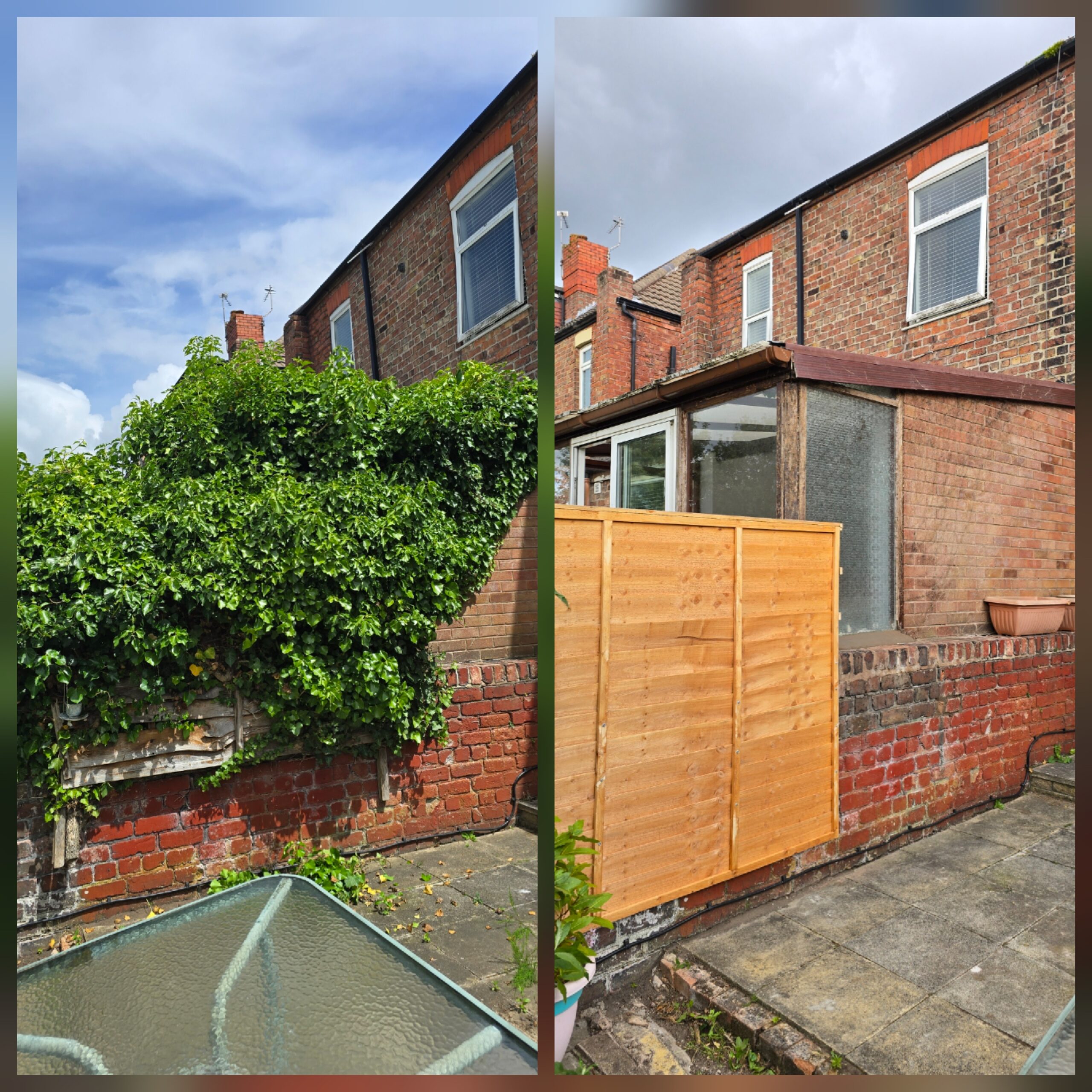
Tight spaces between buildings can make boundary work much harder
Boundary walls and fences are frequently positioned close to sheds, garages, extensions or neighbouring buildings.
Sometimes there is only a narrow gap in which to work.
Limited space affects more than the person cutting the ivy. It can also make it harder to move tools, reach the reverse side of the vegetation and carry cut material out of the work area.
The same issue can occur on house side elevations where a neighbouring building is positioned very close to the wall.
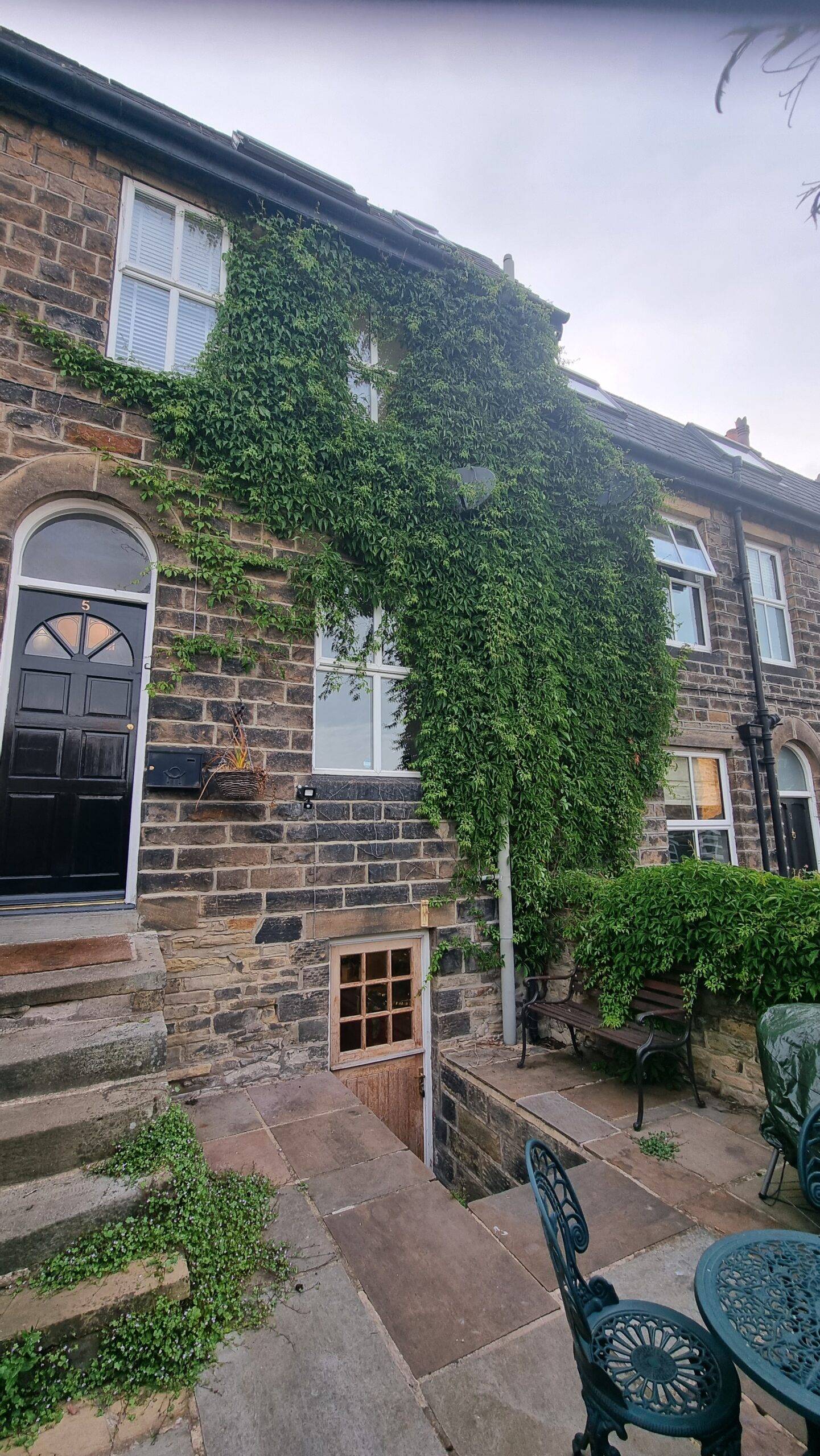
Ivy can spread onto a neighbouring property
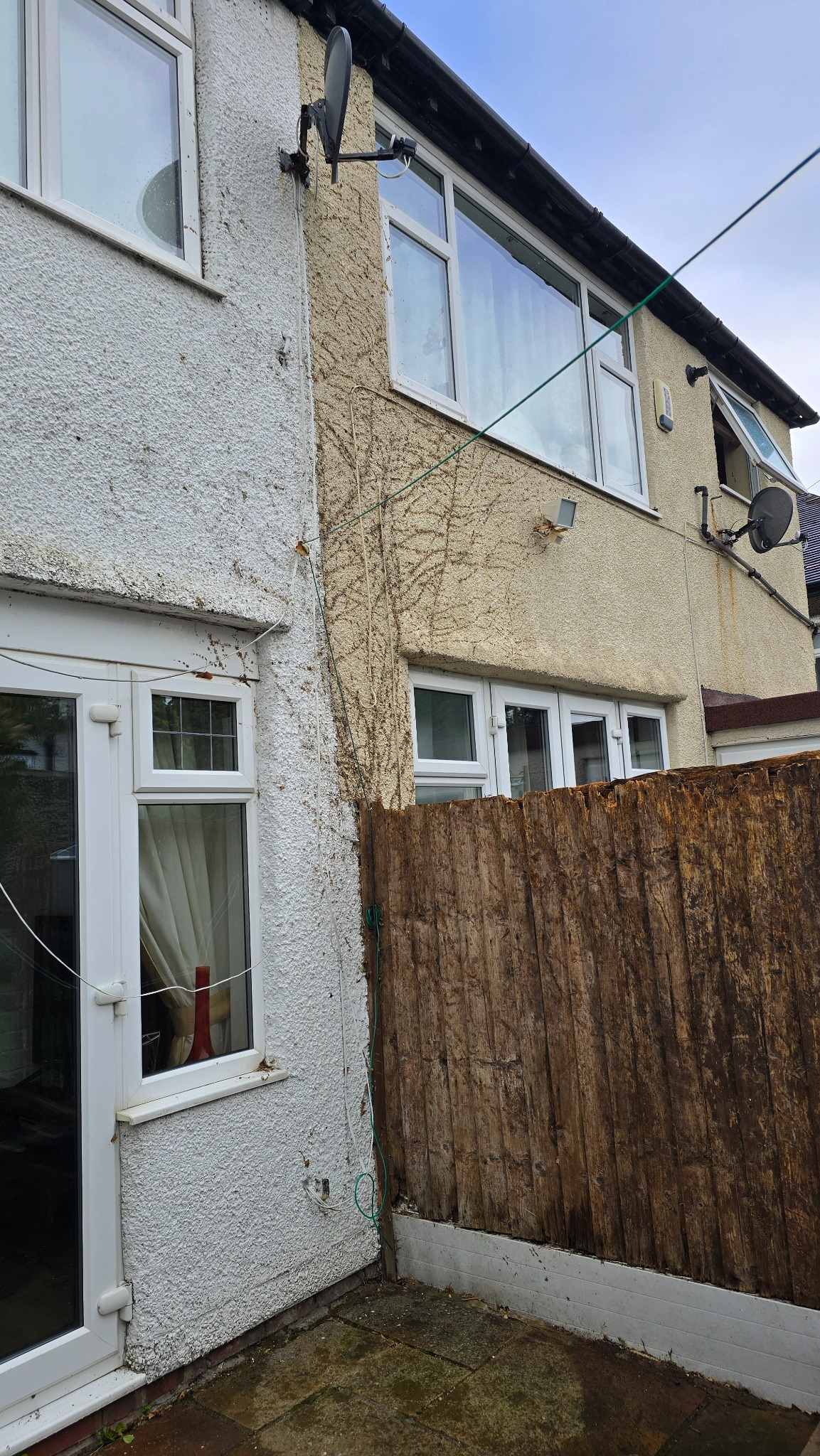
Another complication we encounter is ivy originating from one property and spreading onto a neighbouring building.
It may cross a boundary, attach to the neighbour’s wall or continue towards the neighbour’s roofline.
This can create both an access problem and a practical removal problem.
The side elevation may be too close to the boundary to position a ladder easily from the originating property, and access from the neighbouring side may be needed to remove all the growth properly.
Other plants often need to be saved
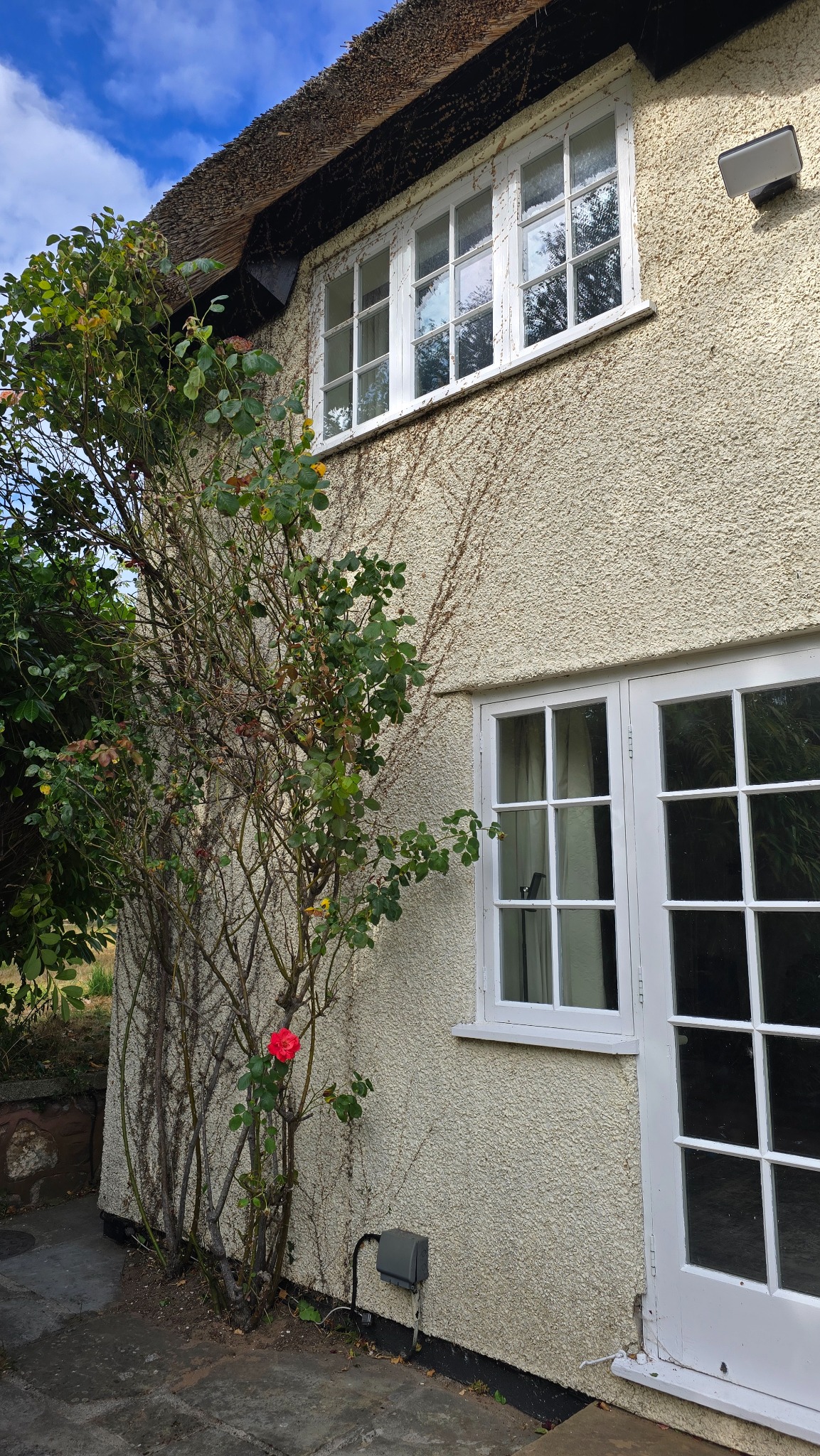
Whether the ivy is growing on a house wall or along a fence, it is often surrounded by vegetation the homeowner wants to keep.
Roses, shrubs, climbers and established garden plants can become intertwined with the ivy.
That means the team cannot simply cut every stem in the area.
The ivy has to be identified and separated from plants that are being preserved, which makes both cutting and access slower.
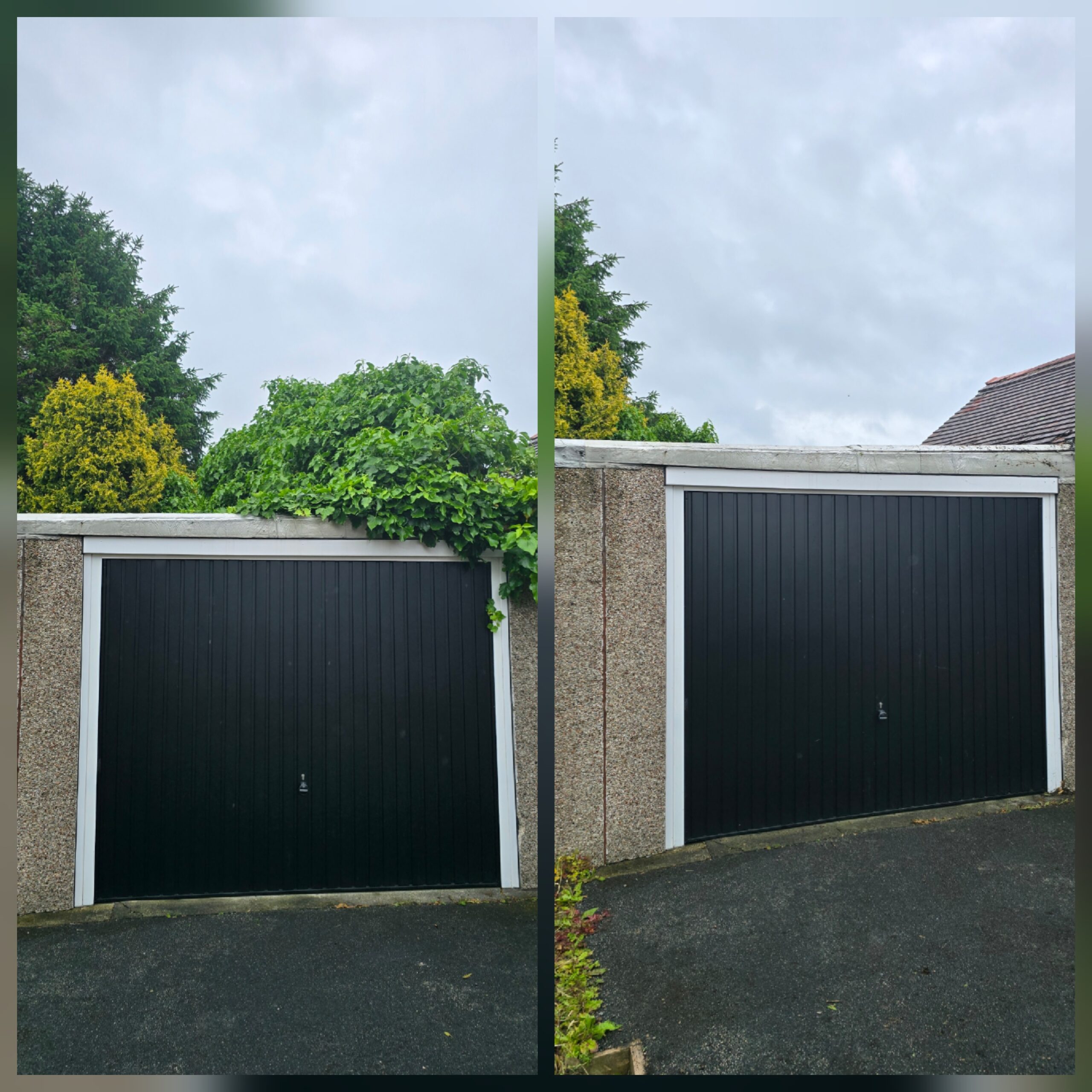
Outbuildings and garages can completely change the access
Another reason photographs can underestimate a job is that the ivy-covered elevation may be partly blocked by garages, sheds, extensions or other outbuildings.
The wall itself may appear straightforward, but the ideal position for ladders or working access may simply not exist.
House ivy vs fence ivy: a practical comparison
| Difficulty factor | House-wall ivy | Fence / boundary ivy |
|---|---|---|
| Height | Often a major factor, especially on two- and three-storey elevations. | Usually lower, although tall boundary structures can still be difficult. |
| Ladder work | Often substantial and can slow progress considerably. | Usually less important, although access conditions still matter. |
| Hidden obstacles | Cables, pipes, windows, vents, brackets and other building features may be hidden behind dense growth. | Posts, rails, adjoining structures and hidden sections of damaged fencing may be concealed. |
| Roofline involvement | Can be one of the most difficult parts of the entire removal. | Usually not applicable. |
| Roots | Often one main stem or a relatively small number of major stems. | Often rooted at several points along the boundary. |
| Both-side access | Occasionally needed, especially when ivy crosses onto a neighbouring property. | Very common when ivy has grown through a fence or boundary. |
| Preserving the structure | Care is required around brickwork, render, gutters, soffits and fittings. | Old or fragile fence panels may require extremely careful removal. |
| Weather | Wind can prevent or delay high-level ladder work. | Usually less affected by wind because much of the work is lower. |
| Entanglement | Can be severe, particularly around gutters, pipes and rooflines. | Often one of the main difficulties, especially when stems pass through both sides. |
| Tight working space | Common beside conservatories, extensions and neighbouring buildings. | Very common where fences run close to sheds, garages and outbuildings. |
Can a smaller fence job take longer than a bigger wall?
Yes.
This is one of the reasons ivy-removal jobs should not be judged only by square metres of visible growth.
A large section of accessible ivy on a straightforward surface may sometimes progress relatively efficiently once the main growth is controlled.
A smaller boundary can take much longer if the ivy is rooted repeatedly, growing through both sides, tangled into other plants and attached to fragile fence panels that need to remain standing.
Likewise, a comparatively small amount of ivy at the roofline of a house can take disproportionately long because the work has to be carried out slowly around gutters, brackets, soffits and tiles.
Why photographs do not always reveal the real difficulty
Photographs are extremely useful when assessing ivy work, but some of the biggest labour factors can be hidden.
A photograph may not show:
- how stable the ground is for ladder positioning;
- whether a conservatory or extension blocks access;
- whether ivy has crossed onto a neighbouring property;
- how much growth is present on the reverse side of a fence;
- whether several stems have rooted independently along the boundary;
- the condition of old fence panels underneath the growth;
- cables, pipework and fittings concealed behind house-wall ivy;
- or how deeply ivy has grown around gutter brackets and beneath the roof edge.
This is why the true complexity sometimes only becomes completely clear as removal progresses.
So which takes more work: fence ivy or house ivy?
There is no single answer that applies to every property.
In our experience, house-wall ivy is often more technically difficult because of height, ladder work, hidden building features, restricted access and delicate work around gutters and the roofline.
However, fence and boundary ivy can be more labour-intensive than people expect. Multiple rooting points, growth through both sides, fragile fence panels, stone-wall gaps and very restricted working spaces can turn a low-level job into a slow and highly manual removal.
The visible height or size of the ivy is only one part of the job. Access, entanglement, what is hidden behind the growth and what needs to be preserved can matter just as much.
Based on real UK ivy-removal work
These observations come from the type of problems we repeatedly encounter while carrying out professional ivy removal across the UK.
They complement the findings in our UK Ivy Removal Report 2026 , which analyses 55 completed ivy-removal projects and the reasons homeowners sought professional help.
This article describes practical observations from our own work. Every property and access situation is different, and an individual site should be assessed on its own conditions.
Need help with overgrown ivy?
Trusted Cleanerz provides specialist ivy removal for house walls, rooflines, fences, boundary walls, garages and other structures across the UK.
If you have photographs of the ivy and the surrounding access, they can help us understand the scale of the work before arranging the next step.